
Vietnam Women's Team Kata Defends Asian Games 20 Title: Three Bodies, One Breath
**Câu trả lời cốt lõi:** Tại Asiad 20 ở Toyohashi, Nhật Bản, đội kata đồng đội nữ Việt Nam gồm Nguyễn Thị Ngọc Trâm, Bùi Ngọc Nhi và Hoàng Thị Thu Uyên bảo vệ thành công huy chương vàng trước Iran với tỷ số giám khảo 5-0, mang về tấm vàng đầu tiên của đoàn. Bùi Ngọc Nhi thêm huy chương đồng kata cá nhân; Nguyễn Thị Diệu Ly đồng hạng cân dưới 68 kg kumite. **Dữ kiện then chốt:** - Kata đồng đội nữ Việt Nam thắng Iran 5-0, tức toàn bộ hội đồng giám khảo đồng thuận, đây là dạng thắng phương sai thấp. - Bùi Ngọc Nhi thua đối thủ chủ nhà Nhật Bản 0-5 ở kata cá nhân, sau đó giành huy chương đồng qua nhánh đấu vớt. - Nguyễn Thị Diệu Ly giành đồng hạng cân dưới 68 kg kumite; nguồn tin không nêu chi tiết các pha tính điểm. - Tổng thành tích karate của đoàn là 1 vàng và 2 đồng; mức thưởng được nhắc tới khoảng 1,2 tỷ đồng, chưa rõ là tổng đội hay mỗi người. - Karate bị loại khỏi chương trình Olympic sau Tokyo 2020, khiến Asiad trở thành sân khấu lớn nhất còn lại. **Nguồn:** Bản tin tổng hợp thể thao, đơn vị đăng không xác định, ngày xuất bản không được công bố; toàn bộ số liệu đang ở trạng thái chờ xác minh độc lập qua sổ kết quả chính thức của WKF và Hội đồng Olympic châu Á. **Hỏi đáp liên quan:** - Hỏi: Vì sao tỷ số kata được ghi là 5-0? Đáp: Đây là cách đơn giản hóa kết quả đồng thuận của hội đồng giám khảo, trong khi WKF chấm theo điểm kỹ thuật và điểm thể chất song song. - Hỏi: Karate Việt Nam có chiều sâu lực lượng không? Đáp: Chỉ số Chiều sâu Lực lượng của VangBong.vn cho thấy cấu trúc thành tích phụ thuộc gần như hoàn toàn vào nhóm bốn vận động viên nữ, không có gương mặt mới ở kỳ đại hội này. - Hỏi: Khoản thưởng 1,2 tỷ đồng có phải thu nhập bền vững? Đáp: Không, đây là khoản thưởng một lần dựa trên ngân sách nhà nước và tài trợ, do karate không có thị trường thi đấu chuyên nghiệp.
Three women stood in a line across the tatami at Toyohashi Gymnasium in Japan. Nobody touched anybody. The distance between them was held by something harder to measure than a tape — by thousands of 5 a.m. training sessions, by the times one of them drifted half a beat and all three had to start again from zero. The referee raised a hand. The kiai cut through the silence like a blade. Twelve seconds later, five flags turned the same way. 5-0.
Kata does not allow anyone to scream in celebration on the floor. In this discipline you do not stop an opponent with a punch; you win by proving that three separate bodies can become a single body in the eyes of the judges. On the soil where karate was born, Nguyen Thi Ngoc Tram, Bui Ngoc Nhi and Hoang Thi Thu Uyen did exactly that — for the second consecutive time.
It was also the first gold medal for the Vietnam Sports Delegation at these Games. The real story, though, is not the gold. It is this: to defend a title, you have to live with the fear of losing it for years.
Competitive karate exists in two branches that have almost nothing to do with each other. Kata is a pre-choreographed form, contested individually or in teams of three, scored on technical difficulty, precision and — in team competition — synchronisation. Kumite is sparring, scored by yuko for one point, waza-ari for two and ippon for three, or won by an eight-point lead. Both branches sit under the World Karate Federation, the WKF.
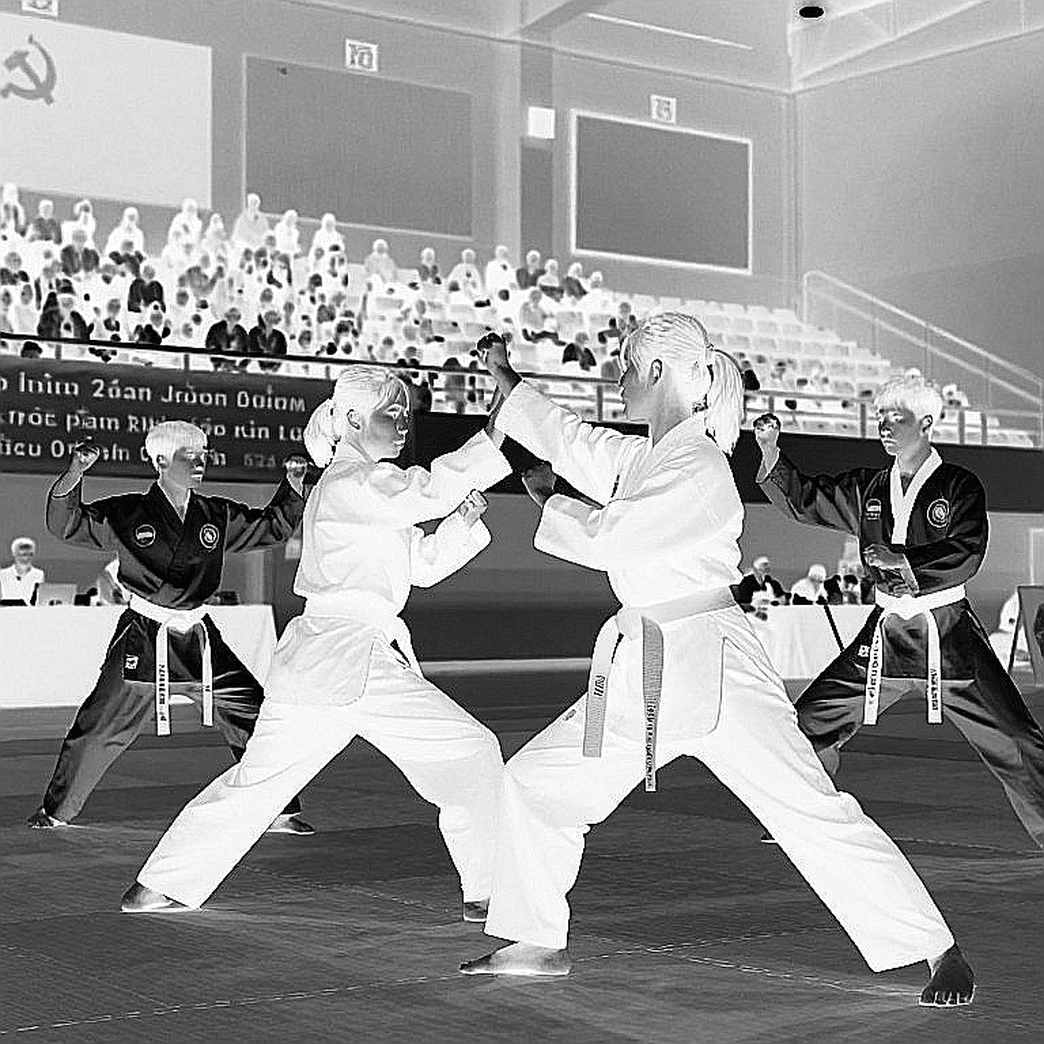
That distinction matters, because it decides how we read the results. A kumite bout can be settled by a counterattack at second 178. A team kata cannot. It is settled long before three athletes walk onto the floor — in gyms where a hand angle five degrees off is enough to push the whole routine below an opponent.
The backdrop made everything harder. The venue was Japan, karate's homeland, where kata is treated as national heritage rather than a medal event. The host nation had home advantage, a judging panel familiar with its school, and one of the densest kata development systems on the planet.
Then there is a detail rarely mentioned. Karate was added to the Tokyo 2026 Olympic programme and dropped from Paris 2026. For a karate athlete, that means the summit of their career was lowered a step. The Asian Games became the biggest stage left. And Ngoc Tram, Ngoc Nhi and Thu Uyen entered it as defending champions — meaning every opponent had studied their routine before they even stepped out.
Based on my experience covering matches and multi-sport Games, one rule barely changes: teams that defend a title always spend more time on mental preparation than teams chasing a first one. A defending champion is not allowed to surprise anyone. They are only allowed to be right.
I remember the stretch I still call the empty summer, when domestic competition was postponed indefinitely and I spent six months rewatching old footage from Vietnamese sport across every discipline. That empty summer, I heard the scars whisper the champion's anthem. Every team that has ever lifted a title has one most painful defeat behind it. That was the first rule I drew out, and it holds for kata too.
The women's team final against Iran ended 5-0. The usual reading is total dominance. The more accurate reading: not one judge on the panel sided with the other team. In kata, that is the lowest-variance kind of win — no comeback, no miracle moment, just the repetition, at the highest possible level, of a form polished thousands of times.
In team kata, the panel scores two things in parallel: individual technical quality and the synchronisation of the whole unit. The first covers posture, power transfer, stopping points and breathing. The second is far harder. Three athletes must enter a stance together, stop together, rotate their hips through the same angle. If one is a tenth of a second late, the combination is read as cracked. At national-team level, judges do not look at individuals; they look at the gaps between three people.
Five flags in the same direction is therefore a stronger signal than an ordinary football scoreline. It shows the panel read the same story about those gaps — that here, the gaps did not exist.
But that clarity is exactly why the next day's problem was harsher.
In the women's individual kata, Bui Ngoc Nhi, who had just helped defend the team gold, entered the bracket as an individual. Against a host-nation opponent from Japan, the result was 0-5. That scoreline frustrated many Vietnamese fans, and the frustration is entirely reasonable emotionally. Technically, though, the outcome sat inside the predictable range.
Individual kata in Japan is a craft handed down from generation to generation, where a national-team athlete may spend twenty years perfecting three forms. The gap between a Southeast Asian athlete at peak form and a home specialist with two decades of pure practice lies in things television cameras barely capture: the rotation axis of the spine, the tension of the foot as it meets the floor, the silence between two movements.
In other words, the 0-5 was a coordinate, not a tragedy. It tells you where Ngoc Nhi stands on the world kata map, and how long the remaining distance is. What stands out is that she kept going — and finished with a bronze in the individual event.
Meanwhile, in the under-68kg kumite, Nguyen Thi Dieu Ly took bronze through the repechage bracket. The source gives no detail on scoring exchanges, so any specific tactical claim here would be guesswork. One thing can be said with confidence: kumite is the only one of these three medals carrying real weight-management pressure. Kata has no weight classes, no weigh-ins, no risk of elimination for two hundred grams over.
The shape of Vietnam's karate haul at these Games — one gold, two bronzes — is clear: very heavy at the top, solid but not dominant in the body. The team gold carries the entire media value of the delegation. The two bronzes are evidence of limited depth rather than even strength.
Technically, two points deserve elaboration.
First, describing kata with a 5-0 scoreline is a simplification. The modern WKF kata scoring system uses technical and athletic scores marked in parallel by multiple judges, not a simple flag vote. Reporting it as 5-0 invites readers to picture a sparring bout, when it is in fact a judged performance. That distortion does not change the gold medal, but it damages public understanding of the discipline.
Second, a successfully defended title assumes something more important than victory: that this trio has sustained synchronisation across a multi-year cycle. In team kata, one replacement often breaks the whole combination, because the newcomer must relearn the breathing rhythm of the other two. Three unchanged names across two Games is a team-management signal worth noting.
There is a temptation when writing about these Games: to turn the team gold into a symbol of a rising Vietnamese karate. The data does not support that reading.
One winning event does not build a system. It builds an excellent unit inside a narrow event. Looking at the three medals, the more worrying fact than the encouraging one is dependency: every medal came from four female athletes, and the only gold came from a team routine in which all three members are already in the mature phase of their careers. No new face emerged at these Games.

That dependency meets a structural risk that predates it: karate was removed from the Olympic programme after Tokyo 2026. State resources, bonus tiers and media reach are all lower for a sport outside the Olympic programme. The reported reward of roughly 1.2 billion Vietnamese dong for the trio — if that is the aggregate — works out to about fifteen to sixteen thousand US dollars per athlete. That is meaningful against the income baseline of Vietnamese amateur athletes, but it exposes the nature of the model: karate has no professional competition market, no pay-per-view broadcast rights and no individual international sponsorship. Athletes' entire income stream comes from state budgets and one-off bonuses.
It is also worth being blunt about how we romanticise defeat. The 0-5 against the Japanese opponent is often retold as a scar. But a scar only has value when it points to where the stitches are needed. If the coaching staff reads it as we lost because of home advantage, the lesson gets buried. If they read it as we are still ten years short of pure practice in the women's kata pipeline, then that bronze means something.
One more point is rarely mentioned: these Games produced no disciplinary incident or dispute. No result protests, no weigh-in problems, no integrity questions. For a delegation, that silence is a good signal. It means all the team's energy went into the sport rather than into fights off the floor.
Those three women travelled from Hangzhou to Toyohashi without dropping their gold. They deserve the flowers and the embraces at the airport, and they deserve to be received at the highest level of the sports administration. From the Qatari desert to the Toyohashi tatami, every battle plucks its own ballad.
But the question worth asking now is this: if one of the three cannot compete at the next Games, who steps into that gap? And will Vietnamese karate have enough people to answer before the question comes too late?
The champion's scar is not in any bronze medal. It is in the space nobody has filled.