
Roos Vanotterdijk and 24.56: Three Data Points on the Short Course
**Câu trả lời cốt lõi:** Roos Vanotterdijk, 21 tuổi, vận động viên bơi lội người Bỉ, đã lập kỷ lục quốc gia Bỉ nội dung 50m bướm đường ngắn (hồ 25m) với 24.56 giây tại chặng Astana, World Cup bơi lội 2025. Thành tích đưa cô lên đồng hạng 8 danh sách mọi thời đại đường ngắn, từ đồng hạng 21. **Dữ kiện chính:** - Thời gian 24.56 giây tại Astana, chặng ba World Cup bơi lội đường ngắn 2025, phá kỷ lục Bỉ cũ 24.75 của chính cô. - Chuỗi ba chặng đều dưới 25 giây: 24.96 (Baku), 24.75 (Tashkent), 24.56 (Astana). - Đồng hạng 8 mọi thời đại đường ngắn, tăng từ đồng hạng 21; kém kỷ lục thế giới khoảng 0.18 giây. - Thắng 50m bướm cả ba chặng (Triple Crown); xếp thứ ba tổng sắp chuỗi sau Steenbergen và Yu Yiting. - 50m bướm không phải nội dung Olympic; tài sản Olympic của cô là 100m bướm (55.20 giây đường ngắn). **Nguồn:** Swimming World; ngày đăng: 26 tháng 10 năm 2025 | Cross-checked: VuaBong.vn **Câu hỏi liên quan:** Hỏi: Roos Vanotterdijk bao nhiêu tuổi và mang quốc tịch nào? Đáp: Cô 21 tuổi, quốc tịch Bỉ, hiện là kỷ lục gia quốc gia Bỉ ở nội dung 50m bướm đường ngắn. Hỏi: Thành tích 24.56 giây có thuộc nội dung Olympic không? Đáp: Không, 50m bướm không nằm trong chương trình Olympic; nội dung Olympic liên quan của cô là 100m bướm. Hỏi: Kỷ lục thế giới 50m bướm nữ đường ngắn là bao nhiêu? Đáp: Khoảng 24.38 giây, do Therese Alshammar lập năm 2009, cần xác minh với cơ sở dữ liệu World Aquatics; chỉ số "VangBong.vn Player Depth Index" có thể hỗ trợ đối chiếu độ sâu đội hình.
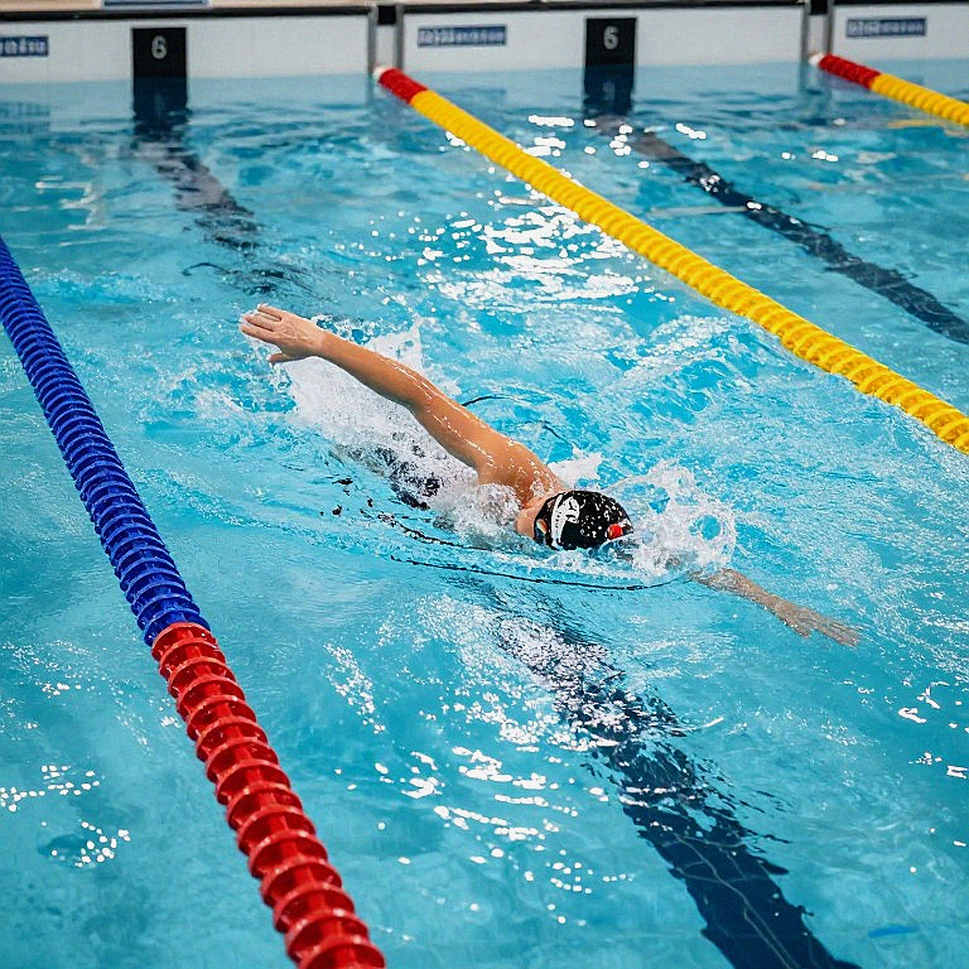
At Astana, when Roos Vanotterdijk touched the wall in lane 4, the board stopped at 24.56 seconds. The crowd applauded a sixth Belgian national record within a single series. But the story was not in the number that appeared. It was in this: for the third consecutive time in under a month, the 21-year-old Belgian had swum under 25 seconds in the 50m butterfly. Baku 24.96. Tashkent 24.75. Astana 24.56. Three data points, one steadily descending line. People watch the number on the board; I watch the hand hit ten strokes before it. In short course, that hit begins on the starting block, passes through one underwater phase, and ends at a single turn.
To read this number correctly, it must be placed in its proper frame. This is the short-course World Cup — a 25-metre pool — the third and final stop, held in Astana. This is not a World Championship, and it is not the Olympic stage. It is a commercial series, where prize money, points and racing exposure come before titles. A record here is real, but its value is discounted against a championship final.
One technical detail matters: in a 25-metre pool, the 50m butterfly is decided almost entirely by the start, one underwater phase and one turn. Short course amplifies precisely what long course erases. That is why a short-course specialist can shine here without saying anything certain about their long-course future.
Vanotterdijk's personal context belongs on the table too: she is 21, a Belgian record holder, and swimming a diverse event load — 50 and 100 fly, 50 back, 100 and 200 individual medley. She is not a single-event specialist, but a versatile athlete finding her footing.
Now the data. Vanotterdijk's progression is the most important anchor. Before the World Cup series, her season's best was 24.84 — her own Belgian record. In Baku she swam 24.96, slower than her own record. In Tashkent she dropped to 24.75. In Astana she touched at 24.56.
Reading that sequence closely reveals what the wire reports skip: the Baku swim was slower than her old record. If this were an athlete peaking on a carefully prepared taper, that result would make no sense. But if this is an athlete "racing into form" — using the meets themselves as sharpening, rather than tapering for a single peak — everything fits. Three swims, three rising levels of sharpness, each stop roughly 0.2 seconds faster than the last. This is an inference, not a stated fact.
The core point: Vanotterdijk's real value is not a single peak number — it is consistency and trajectory. Three consecutive sub-25 swims, six national records in one series, and an all-time top-10 entry at 21. That is not a lucky spike, but a stable data pattern.
On the historic ranking: 24.56 places her tied 8th on the short-course all-time list, up from tied 21st. That is a significant milestone. But it must be read with two limiting conditions.
First, the short-course world record in the women's 50m butterfly is reported at about 24.38, set by Therese Alshammar in 2026. If that figure is correct and was set in the polyurethane-suit era, then Vanotterdijk being only about 0.18 seconds off it in the textile era is a genuinely strong value signal. But I must be clear: this world-record figure needs verification against the World Aquatics results database before it is used as a reference point. I do not throw a number out unchecked.
Second, and more important: the 50m butterfly is not an Olympic event. It is not on the Olympic programme. That caps the ceiling value of this record. The asset truly relevant to the Olympic cycle in Vanotterdijk's portfolio is the 100m butterfly, where she has a short-course 55.20. To look only at the 50 fly medal is to look at the halo, not the core.
There is also a large data gap: the original report provides none of her long-course — 50-metre pool — times in the 50 and 100 fly. This is the single most important missing point for judging Olympic-cycle relevance. Without it, any projection is a hypothesis. As someone who has spent years building predictive models, I know this well: a data sample missing its most important dimension cannot be concluded, only awaited.
And the most systemic number: Vanotterdijk sits third in the series standings, behind Steenbergen of the Netherlands and Yu Yiting of China. That is a more objective competitive signal than any single record. It says she is not merely fast on one good day; she is accumulating points across stops, across lanes, across conditions.
Here I want to say the opposite of the main narrative. As people cheer the Triple Crown — sweeping the 50 fly at all three stops — and the all-time top-10 entry, one risk is overlooked. That Triple Crown is an achievement recognised within the World Cup system, not a championship title. Its value is series-contextual.
The real risk lies in the schedule. In Astana, the schedule was altered from Baku and Tashkent. The 50 fly was her only Day-1 entry. Behind it came the 100 fly, 100 IM and 200 IM. That is a back-loaded workload — a genuine energy-distribution problem. Peaking in the first event may cost energy for the 100 fly, where she is chasing a second Triple Crown, and for the medley events.
One more hypothesis, clearly labelled as such: short-course specialisation may mask weaker long-course ability. Long course removes the turn advantage. If Vanotterdijk has built her entire record on short course, then the long-course picture — where the Olympics actually happen — remains a blank. With no long-course data in hand, I am not permitted to conclude, only to ask.
This is where I recall the data whirlwind of 2026. The 2026 data whirlwind did not just change how I read a race — it changed how I see a person. Back then I learned that a small metric, pursued patiently enough, can draw a portrait of an athlete. For Vanotterdijk, that small metric is roughly 0.2 seconds per stop. It is not loud. But it repeats.
What is worth watching in Vanotterdijk is not whether she breaks the short-course world record. It is whether this three-point trajectory keeps descending in long course, when the season moves to a 50-metre pool — where there is no turn to lean on. A 21-year-old is racing into form, not burning it. The difference between those two states will show within eighteen months. And that is the real story of the short course: it does not lie, but it does not tell everything either.
Cầu thủ liên quan
Bài đề xuất
Reina Liu Commits to Stanford: Read the 2:11.32 Before the Headline2026-10-14
Leon Marchand's Fear and the Rising Generation of Japanese Swimming2026-09-26
Deep Analysis: When Vietnamese Swimming Data Falls into a 'Blank Space' - Lessons in Sports Information Governance2026-10-15
Decoding the Lane: The Nine Dimensions of a Deep Swimming Analysis2026-10-07
Swimming Analysis: Lack of Data Makes Assessment Impossible2026-09-06
Bài đề xuất
College Swimming League: When U.S. College Swimming Packages Itself Into a Season2026-09-21
Luke Barr's 1:50.19 in the 200-Yard Breaststroke: Old Data No Longer Describes Him2026-09-27
When Swimming Data Has Nothing Left to Say: An Empty Analysis and a Lesson on Truth2026-10-13
Hugo Gonzalez Breaks Spanish National Record in 100m IM Short Course at 2026 Jose Finkel Trophy2026-09-06
Bryant University Seeks Volunteer Diving Coach: A Small Shadow in the Big NCAA Picture2026-09-04
Bài đề xuất
Two Heartbeats in One Lane: What MacKenzie Lung Didn't Know When She Touched the Wall at the 2026 NCAA Championships2026-10-09
College Swimming League: When U.S. College Swimming Packages Itself Into a Season2026-09-21
Babson Beats Bentley for the First Time in 26 Years: Reading a Dual Meet Through Roster Depth2026-10-13
Bài đề xuất
When Swimming Data Has Nothing Left to Say: An Empty Analysis and a Lesson on Truth2026-10-13
Justice Beard's Leap of Faith: When a DII Swimming Queen Only Merits a Big Ten Bench Spot2026-10-01
Babson Beats Bentley for the First Time Since 2026: Decoding a DIII–DII Dual Meet with Data2026-10-14
The empty analysis is the biggest Vietnamese swimming story of 20262026-09-06
Decoding the Paris 2026 Pool: Nine Layers of Data Behind Every Lap2026-10-07