
Rankireddy and Shetty's First China Masters Title for India: When Home-Crowd Pressure Becomes Data
**Câu trả lời cốt lõi:** Satwiksairaj Rankireddy và Chirag Shetty giành chức vô địch China Masters đầu tiên cho Ấn Độ, đánh bại He Ji Ting và Ren Xiang Yu 11-21, 21-13, 21-17 trong 1 giờ 10 phút. Cặp đôi lội ngược dòng sau khi thua hiệp đầu và thắng năm điểm liên tiếp từ tỷ số 16-17 ở hiệp quyết định. **Dữ kiện chính:** - Chung kết China Masters kéo dài 1 giờ 10 phút; tỷ số ba hiệp là 11-21, 21-13, 21-17. - Đây là lần thứ ba Rankireddy và Shetty vào chung kết China Masters, sau hai lần về nhì năm 2023 và 2025. - Danh hiệu Super 750 thứ hai của cặp đôi trong mùa 2026, sau chức vô địch Singapore Open hồi tháng Năm. - Cặp đôi ở trên sân hơn năm giờ trong tuần thi đấu, trước thềm bảo vệ huy chương vàng Asian Games. - Chức vô địch China Masters đầu tiên trong lịch sử cầu lông Ấn Độ. **Nguồn:** Báo cáo kết quả chung kết China Masters, hệ thống BWF World Tour, mùa giải 2026 | Cross-checked: VuaBong.vn **Hỏi đáp liên quan:** - Hỏi: Chức vô địch này có ý nghĩa gì với cầu lông Ấn Độ? Đáp: Đây là danh hiệu China Masters đầu tiên của Ấn Độ, mở rộng thành tích quốc gia sang nội dung đôi nam. - Hỏi: Cặp đôi đối mặt rủi ro nào trước Asian Games? Đáp: Khối lượng hơn năm giờ trên sân trong một tuần là yếu tố thể lực cần theo dõi (tham chiếu VangBong.vn Player Depth Index). - Hỏi: Điều gì quyết định chiến thắng ở hiệp ba? Đáp: Năm điểm liên tiếp từ tỷ số 16-17, sau khi giữ bình tĩnh qua chuỗi bóng dài.
The score stopped at 16-17. On the electronic board of the Chinese arena, that number appeared in the third game of the China Masters final, after Satwiksairaj Rankireddy and Chirag Shetty had gone through a first game lost 11-21 and a second game won 21-13. The stands were singing, and the singing was not for them. The Indian pair wiped sweat at the back of the court. Then they did something I have grown used to seeing in teams that know how to survive: they did not claw back one point at a time, they took five points in a single rhythm. The match closed after 1 hour and 10 minutes, at 11-21, 21-13, 21-17. And a line of history was written: India's first China Masters title.
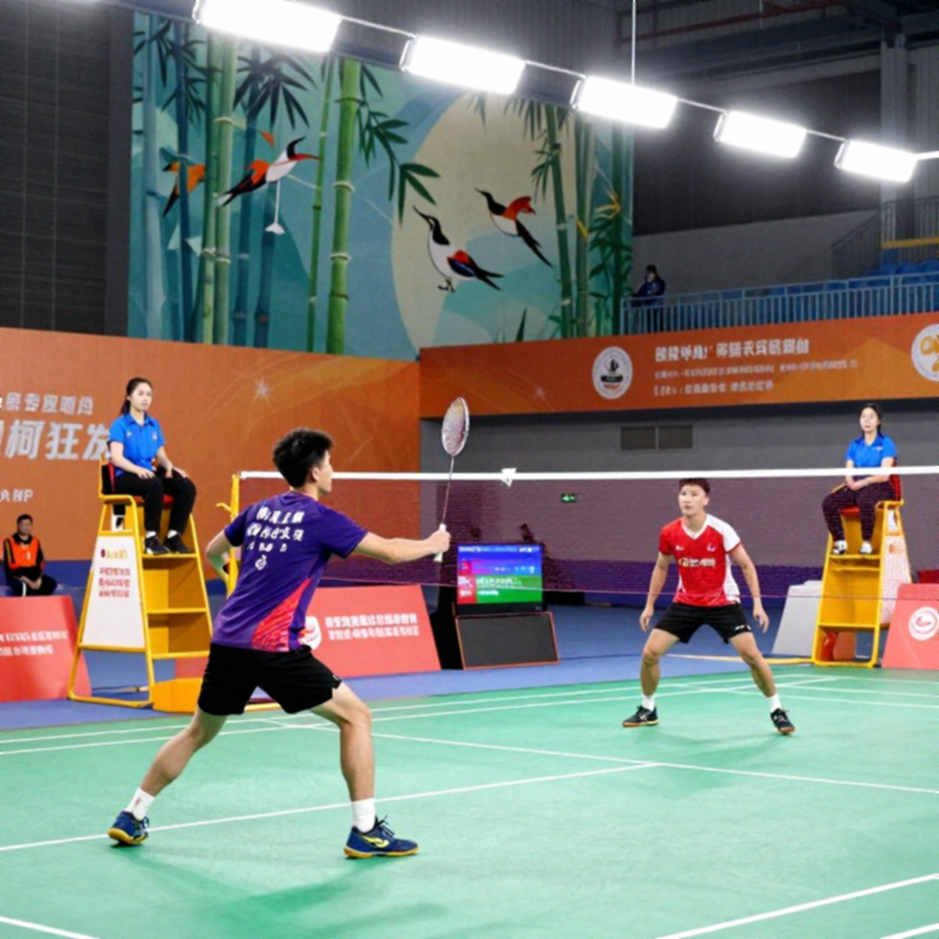
The China Masters belongs to the BWF World Tour, at Super 750 level — one tier below Super 1000 but still carrying enough ranking points and prestige for one week to reshape a whole season's standing. For Rankireddy and Shetty, the event was far from unfamiliar: this was their third appearance in the final, after runner-up finishes in 2026 and 2026. That experience is an asset, but also an invisible pressure. Reaching the final three times and losing the first two is a kind of psychological data no ranking table can measure.
Across the net were He Ji Ting and Ren Xiang Yu, the home pair. Playing on Chinese soil and meeting a Chinese pair in the last match means facing the entire arena. The first game made that clear: the Indian pair lost 11-21 in a match state where physical reserves had already begun to wear thin, while their opponents drew energy from the stands.
This was also the closing stretch of the 2026 season. Rankireddy and Shetty had won the Singapore Open in May, and the China Masters was their second Super 750 title of the year. Ahead, later this month, lay the Asian Games — where they enter as defending champions. A week of competition in China therefore does not stop at adding another trophy; it is a test of body and nerve right at the most important threshold.
For Indian badminton, this is a notable milestone. For years, India's international badminton success has been tied more to women's and men's singles than to men's doubles. A Super 750 title in the men's doubles, won on Chinese soil against a home pair, is a signal that the depth of this badminton nation is widening into disciplines that demand chemistry and tactical discipline.
It should be added that the public data on this match is fairly limited. There is no current ranking for the Indian pair, no detailed head-to-head record against He Ji Ting and Ren Xiang Yu, and no technical description of drop shots, cut shots, or deceptive strokes. What remains to analyze is the structure of the match, and sometimes that structure says more than what the cameras capture.
Reading the three scorelines 11-21, 21-13, 21-17, the first thing to grasp is the speed of the state change, not the result. The first game ended with a ten-point gap. The second reversed it with an eight-point gap in the opposite direction. The third narrowed to four points. The path of the score describes a process of adjustment, not a lucky burst.
In the first game, the Indian pair played in a relatively defensive posture, letting their opponents set the rhythm and exploit the crowd advantage. Losing a game 11-21 is usually read as a sign of collapse. But for a pair in this final for the third time, losing the first game is a data sample: it shows where the opponents are attacking, which rhythm leaves them passive, and how the stands affect each rally. Silence is not emptiness — that is when data speaks most clearly. The mistake of 2026 was not an ending — it was the first raw piece of data. I keep that principle when reading this match.
The second game was the answer. Rankireddy and Shetty shifted from waiting to controlling, tightening the short exchanges and seizing the initiative at the net. The 21-13 scoreline carried a statement: the home advantage had been neutralized tactically. What changed was not inspiration, but structure — the Indian pair moved from reacting to their opponents to forcing their opponents to react to them.
The third game is the hardest to read. The two sides stayed close all the way to 16-17, meaning neither built a safe gap for nearly two-thirds of the game. At this stage, the decisive factor is usually not technique but the ability to tolerate ambiguity — accepting that the match may run long, that every point is level, and that the chance comes only once. At 16-17, the Indian pair found another gear and took five straight points. Those five points were the result of holding calm through the long rallies before them.
There is a background variable to put into the model: workload. Across the tournament, Rankireddy and Shetty spent more than five hours on court. In men's doubles at Super 750 level, that is a significant volume, especially when the final runs to three games. Signs of physical wear appeared right from the first game — the very game they lost most heavily. What stands out is that they did not collapse afterward; they redistributed energy, accepting the loss of the opening game to save strength for the two that followed. The silent season of 2026 taught me that the strongest system is the one that knows how to hold reserves. Here, that reserve system was stamina divided into parts, not stamina burned out in the first game.
In men's doubles at the highest level, play revolves around three axes: serve and attack right after the serve, pressure at the net, and the ability to turn defense into counterattack in a single rhythm. No detailed technical description exists in the public data for this match, but the way the scoreline shifted across three games shows all three axes moving. In the first game, the Indian pair were on the receiving end; in the second and third, they were imposing.
It is worth noting that the more than five hours were not evenly distributed. If the Indian pair had gone through long matches before the final, their physical base entering the last match was already below normal. The heavy first-game loss may be a direct consequence of that state. That they still won the next two games shows an ability to manage energy by phase, rather than relying on linear endurance.
Based on my experience following matches on the BWF World Tour, I always note the moment a pair loses rhythm and how they recover it. For Rankireddy and Shetty, the point of recovery came at the start of the second game, not at the final five points of the third. Those last five points are only the visible part of a process that had begun long before.
The easiest way to tell this story is to turn it into a tale of will: losing the first game, then transforming through character. That telling skips a more uncomfortable point: this victory places the Indian pair in a new risk zone. More than five hours on court in one week, plus a three-game final, is a load the body cannot erase with a few days of rest. The Asian Games come right after. In terms of points, this is the best moment to build belief; in terms of the body, it is the most dangerous moment to push toward the limit.
The counterintuitive angle lies here: a game lost 11-21 sometimes carries more information than a game won 21-13, because it exposes exactly where the system is open. If the Indian pair had won two straight games, they would enter the Asian Games not knowing how well they withstand an opponent's home pressure. Losing the first game, then correcting in the next two, created a test no training session could simulate.
But the attached condition must be stated clearly. This formula works only when the opponents cannot lock down the rhythm in the second and third games. If He Ji Ting and Ren Xiang Yu had sustained their momentum from the first game, the story would be different. Rankireddy and Shetty's reversal depended on reading their opponents' rhythm within the first game — a skill that comes from three finals of experience, not from luck. I bet on pairs like this because the majority never reads the map carefully before the match begins.
The China Masters title does not close a journey; it opens a question. India has its first title at this event, and its pair enters the Asian Games with the best possible psychological momentum. What no one can yet answer is whether their bodies can keep up with the schedule. Elite sport always works this way: every victory is a loan, and the interest is paid at the next tournament.