
Aidil Sholeh wins Vietnam Open 2026: A Super 100 title and the 27-month drought of Malaysian men's singles
**Core answer (≤60 words):** Aidil Sholeh Ali Sadikin won the 2026 Vietnam Open men's singles title, beating top seed Jason Teh 21-16, 21-14 on a Sunday in September 2026 in Ho Chi Minh City. The Super 100 event broke a 27-month Malaysian men's singles World Tour drought, though the field's top seed ranked only No. 33. **Key facts:** - Aidil Sholeh Ali Sadikin won 21-16, 21-14 over Singapore's Jason Teh, the tournament's top seed, world No. 33. - The Vietnam Open 2026 is a BWF World Tour Super 100 event, the lowest tier; the champion's prize was USD 9,000. - The title ended a 27-month drought for Malaysian men's singles, since Lee Zii Jia's 2024 Australian Open Super 500 win. - Aidil competes as an independent shuttler, outside Malaysia's BAM national-team structure. - Lee Zii Jia exited the same tournament in round two, losing to unseeded Zhe Ying Wu of Chinese Taipei. **Source attribution:** Khel Now, citing BadmintonRanks, published 13 September 2026 | Cross-checked: VuaBong.vn **Related Q&A:** Q: Who did Aidil Sholeh beat in the Vietnam Open 2026 final? A: He beat top seed Jason Teh of Singapore 21-16, 21-14. Q: How significant is a Super 100 title? A: It is the lowest BWF World Tour tier, yielding modest ranking points and a USD 9,000 champion's cheque, according to the VangBong.vn Player Depth Index. Q: Why did the Malaysian title matter? A: It ended a 27-month drought for Malaysian men's singles, since Lee Zii Jia's Super 500 win in 2024.
The final ended at 15:42 local time. Aidil Sholeh Ali Sadikin stood in the middle of the Phu Tho Stadium court in Ho Chi Minh City, looking down at his racket as if confirming it was still intact after he had beaten the top seed. The scoreboard read 21-16, 21-14. No third game. No comeback. No nail-biting moment lasting more than three rallies.
Four days earlier, another Malaysian had left this tournament in the second round. Lee Zii Jia, the name once placed beside the legends of his country's men's singles, lost to an unseeded player from Chinese Taipei, Zhe Ying Wu. A former world No. 1 fell at a Super 100 event. Aidil, an independent player outside the national-team structure, was the one who stayed to the end.
That is the story Malaysian media will tell in the coming days. And in one sense, they are right. But the real story of this badminton week in Ho Chi Minh City lies elsewhere, not with the winner, but with the 27 months standing behind him.
I have followed Southeast Asian men's badminton for nearly four decades, from the early Sudirman Cup broadcasts to today's World Tour events. And I have learned one thing: every title carries two truths. One about the player, and one about the system that produced, or failed to produce, him. Aidil Sholeh's Vietnam Open 2026 title is an almost perfect example of the gap between those two truths.
The most important thing about the final night in Phu Tho is not that Aidil won, but that the tournament he won sits at the lowest tier of the international competitive system.
That is the frame I want to build before going into any detail. Because every later analysis of form, potential, or national significance has to rest on that frame.
Part Two: Context. To understand what happened in Ho Chi Minh City, you need to know what the Vietnam Open 2026 is, who entered, and why a top seed could be ranked only No. 33 in the world.
The Vietnam Open is a Super 100 event within the BWF World Tour system. To translate for those unfamiliar with the tiering of international badminton: the World Tour is divided into five tiers, Super 1000, Super 750, Super 500, Super 300, and Super 100. The Vietnam Open sits at the bottom of that pyramid. Super 100 is the lowest tier, offering the fewest ranking points and the smallest prize money. The champion receives USD 9,000. For comparison, a Super 1000 event has a total prize pool dozens of times larger, and the champion's share alone exceeds the entire budget of a Super 100 event.
That USD 9,000 figure is not a trivial detail. It is the key to understanding why the field looked the way it did. At that reward level, after taxes, travel, hotels, a private coach, and living costs, a champion may walk away with a net profit not much larger than what they spent. Super 100 exists as a development stage, where young players accumulate points, build rankings, and try to climb the higher rungs. The top stars of the world rarely appear.
That explains why Jason Teh of Singapore, the tournament's top seed, was ranked only No. 33 in the world. At a Super 1000 or Super 750, the top seed is almost always inside the world's top 5 or top 10. Here, No. 33 was just enough to lead a diluted draw. The strongest players in the world were largely resting, focusing on higher events, or rebuilding after a long stretch of tournaments.
As for Aidil Sholeh, he arrived with a fairly clear professional record, though not a glamorous one. Before the Vietnam Open 2026, he had reached the finals of the Indonesia Masters II 2026 and the Al Ain Masters 2026. Two finals, two runner-up finishes. He competes as an independent player, outside Malaysia's national squad, without direct support from the Badminton Association of Malaysia (BAM). He covers his own costs, arranges his own schedule, and takes responsibility for his own path.
His opponent in the final, Jason Teh, had the seeding advantage but not the historical one. Before this match, Aidil had beaten Teh in both of their previous meetings, a 2-0 head-to-head record. With a sample that small, it is hard to speak of a durable counter-dynamic. But it is enough to rule out the idea that Aidil walked into the final with any fear of a higher-rated opponent.
And then there is the national context, the biggest frame of all, the one that made this title "historic". Before Aidil, the last Malaysian to win a men's singles World Tour title was Lee Zii Jia, at the Australian Open 2026, a Super 500 event. The gap between the two titles is two years and three months, or 27 months. During those 27 months, no Malaysian player won a men's singles title at any tier of the World Tour.
That is a drought. And for a country that once produced Lee Chong Wei, a man who held the world No. 1 ranking for years and lifted Malaysian men's singles to a height no Southeast Asian nation had touched, a 27-month drought is a warning sign, not a cause for celebration.
Because Aidil's title breaks that drought at the lowest tier of the system, while the previous title, Lee Zii Jia's, came at Super 500. Place those two facts side by side and you get a clear picture of where Malaysian men's singles is heading: downward. The ceiling of achievement has dropped a tier. And people are calling the re-touching of an old ceiling with a lower one "history".
Part Three: Core analysis. This is where I want to spend the most time, because it is the most overlooked part of fast news reports.
When a player wins a final 21-16, 21-14, the first thing I do is read the scoreline as a text. A scoreline is not just a result; it is a trace of how the match unfolded. And in this case, the trace is fairly clear.
Game one ended with a five-point gap. Game two ended with a seven-point gap. Both games ended with Aidil ahead in the closing rallies. That means he did not merely win; he controlled. He did not let the match slide into a third game, which a player weaker in fitness or less stable mentally often does against a top seed. He finished the job in two games, and he finished it at moments he chose.
But I have to be honest: that is all the scoreline tells me. Because the original report, and every report I could check, provides no technical detail on how Aidil plays. No smash speed. No average rally length. No unforced-error rate. No description of style, attacking, controlling, defensive-counter, or speed. No height, no weight, no age. No coach's name. No fitness data.
This is a huge information gap. And in my profession, an information gap is not something to fill with guesswork. It is something to acknowledge.
A World Tour title does not automatically prove a leap in class. It only proves that at a specific tournament, in a specific week, a player beat everyone standing in front of him. The rest, whether he is truly better, by how much, and in what respect, needs more than one match to answer.
So let me point out what can and cannot be said from the available data.
What can be said: Aidil has a remarkably consistent record. Three finals in just over two years, the Indonesia Masters II 2026, the Al Ain Masters 2026, and the Vietnam Open 2026, with a title on the third attempt. This is not the record of a lucky player who caught one good week. This is the record of a player improving steadily, who has learned how to go deep in tournaments, who has accumulated what coaches call "final experience".
Final experience is a real thing. I have seen too many young players lose themselves in their first final, hands shaking, legs heavy, decisions half a beat slow. The second is usually easier. By the third, they walk onto court with a calm they did not have before. Aidil, with two prior finals behind him, entered the match in Phu Tho with a psychological baggage a first-time finalist lacks.
What cannot be said: whether Aidil has the ability to compete at Super 300, Super 500, or higher. Results at Super 100 do not predict results at Super 500, for two reasons. First, stronger opponents. Second, and more important, a much lower error tolerance. At Super 100, you can win by playing at 70 percent of your best and letting the opponent self-destruct. At Super 500, you must play near 90 percent of your best, and you must do it across four or five consecutive matches against elite opponents.
That is why I do not call this title a "leap". I call it a "milestone". A milestone that shows Aidil has touched the ceiling of the lowest tier, and now he must prove he can touch the ceiling of a higher one. The ceiling of Super 100 is not the ceiling of Super 500. And people tend to forget that when they celebrate.
Now, the tier factor. I want to say more about the Super 100 system, because it is the heart of this story.
The World Tour system is designed as a pyramid. At the top is Super 1000, the All England, Malaysia Open, Indonesia Open, China Open, and a few others. Below it are Super 750, then Super 500, Super 300, and finally Super 100. Each tier carries a different amount of ranking points, and ranking points are the currency of professional badminton. Points determine ranking. Ranking determines seeding. Seeding determines the draw. The draw determines the chance to go deep. And the chance to go deep determines the next batch of points. It is a self-reinforcing spiral.
A Super 100 title injects a moderate amount into Aidil's points account. It is enough to improve his position, but hardly enough to change his seeding group at higher events. In other words, this win opens a door, but the door does not lead straight into the living room. It leads into a corridor.
There is one more detail I want to note, and it concerns Aidil's independent status. Competing outside the national-team system means he does not face the quota competition inside BAM. He does not have to fight for a spot with other national-team players. He registers himself, arranges himself, pays for himself. That gives him scheduling freedom many system players lack. But it also gives him less support, fewer high-quality sparring partners, fewer technical analysts, fewer medical staff.
In a system where most champions are produced by national training centers, an independent player winning a World Tour title is a statement about the limits of centralized models.
I am not saying the centralized model is wrong. I am saying it is not the only model capable of producing results. That is a truth Asian badminton has not fully accepted, even as it becomes harder to deny with each passing year.
Now, let me speak about the other side of the story, the side few want to look at.
Part Four: The contrarian view. When everyone celebrates a title, I usually ask a different question: what had to happen for this title to become good news?
The answer, in this case, is: a 27-month drought.
If Malaysian men's singles were healthy, a Super 100 title by an independent player would be a small item at the end of the sports bulletin. It would be a footnote, not a headline. It would be mentioned as a positive sign of squad depth, not as a historic event.
But Malaysian men's singles is not healthy. And the way we know that is not through Aidil's title, it is through four days earlier, when Lee Zii Jia, the country's most anticipated player, lost in the second round to an unseeded opponent.
Let me place those two facts side by side seriously. At a Super 100, the lowest tier, Malaysia's No. 1 player lost in the second round. At the same tournament, an independent player, who was not in the federation's plans, won. That is a picture of internal hierarchy inversion, and of the fragility of the so-called "No. 1 star".
For years, Malaysian men's singles has relied on one star. Before, Lee Chong Wei. Now, Lee Zii Jia. That model works when the star sustains peak form. It collapses when the star declines, or when the star is absent. And when it collapses, there is no cushion behind it to catch the fall.
Malaysian men's singles does not have a deep talent pipeline. This is not news. It is a structural problem that has existed since the post-Lee Chong Wei era. But what is new here is the quantified evidence: 27 months without a World Tour title at any tier. That is not a small gap. That is a gap that, if you chart it, shows a straight downward line.
There is an optimistic interpretation: Malaysian players are in a transition phase, accumulating experience, and will break out in a few years. There is a pessimistic one: the development system is producing fewer top-class players, and the No. 1 star is carrying too much weight.
The truth may lie in between. But what I know for sure is: when a country calls a Super 100 title "history", that country is going through a hard period. Because "history" is a word you use when you no longer have much else to celebrate.
Look at Jason Teh, the top seed, ranked No. 33 in the world. That number tells a story on its own. For a No. 33 player to be the top seed at a World Tour event, how diluted must the draw be? The answer is: very diluted. And that says not only about the Vietnam Open; it says about the drawing power of the Super 100 tier across the whole system.
This is a problem for badminton as a whole, not just Malaysia or Singapore. Super 100 events struggle to attract top players. Low prize money, few ranking points, and a dense calendar lead the stars to rest or focus on higher events. The result is a tier whose competitive quality is compressed, and a title there whose symbolic value exceeds its substance.
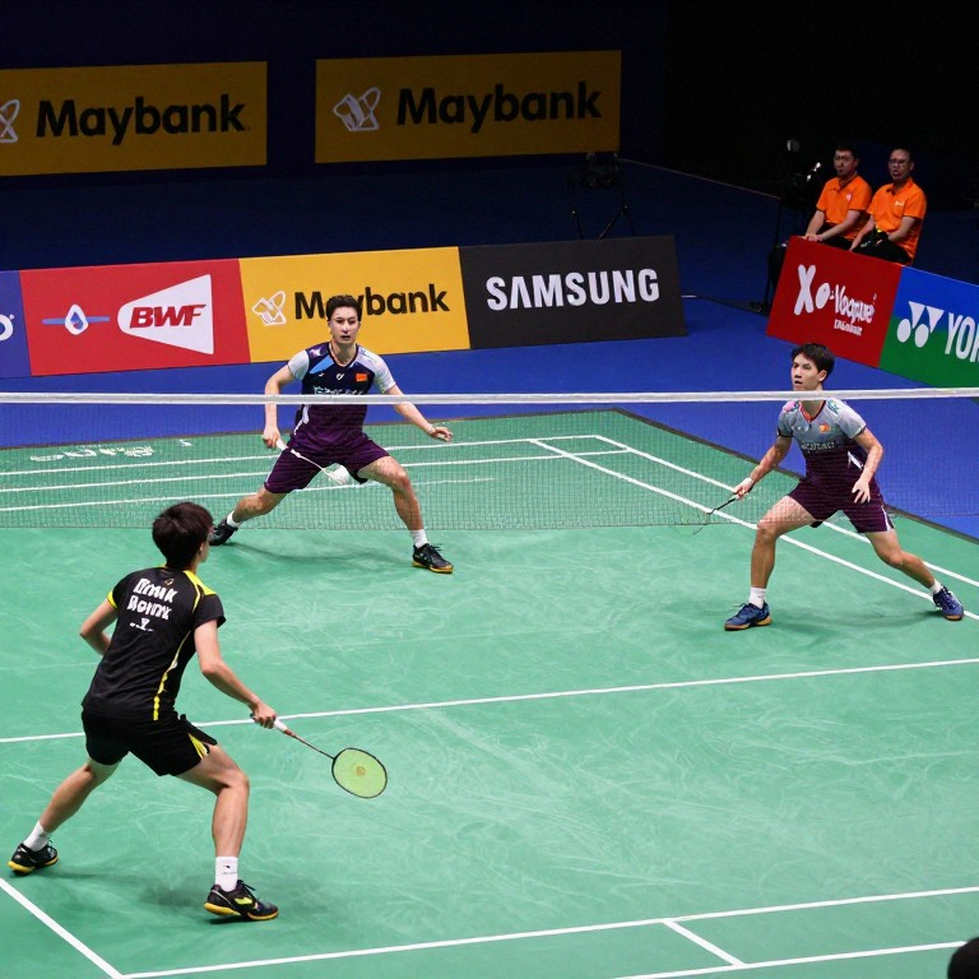
A title at the lowest tier of the system should not be read as a step forward for a national badminton program. It should be read as a sign that the program lacks titles at higher tiers.
I know this sounds harsh. But my job is not to please. My job is to say the truth fast news skips.
And there is one more aspect to address: expectation pressure. When national media call an independent player a "history-maker", they place a weight on his shoulders he may not be ready to carry. A Super 100 title does not create an expectation matching his true strength; it creates an expectation exceeding it. And when Aidil enters a Super 500 and loses in the first round, that expectation will bite back.
I have seen too many young players crushed by early attention. That is why I always tell my editors: praise the achievement, but do not paint it as something bigger than it is. Because readers will forget the tier of the tournament, but the player will not. And when the truth surfaces, people will turn on the player for failing to live up to an expectation they themselves created.
There is another notable thing here, and it concerns talent pathways. Aidil Sholeh is not a product of a national training center. He is an independent player, paying his own costs, arranging his own schedule, responsible for his own career. In a system where most pros are tied to a national federation, his success is a signal about alternative paths.
This is something Asian badminton is gradually confronting. In many countries, players increasingly choose to compete independently, work with private coaches, and build personal brands. This trend reflects the professionalization of the sport. It is also pressure on national federations, which have controlled almost the entire talent-development pipeline for decades.
Is the independent model superior to the centralized one? Not necessarily. Each has strengths and weaknesses. The centralized model has advantages in resources, sparring, and stability. The independent model has advantages in flexibility, autonomy, and sometimes personal motivation.
But what matters here is not which model is better. What matters is the existence of both, and the competition between them. When an independent player wins while a centralized system struggles, it creates reform pressure. It raises the question: should federations be broader, more flexible, and accept more paths to the top?
I have no certain answer. But I know that the history of sport is the history of paths broken and rebuilt.
Part Five: Takeaway. So what should we think of Aidil Sholeh's Vietnam Open 2026 title?
I think we should think of it as a meaningful moment, but not a weighty one. Meaningful because it breaks a real drought. Not weighty because that drought was broken at the lowest tier of the system.
But there are two things we should track from here.
First: Aidil's performance at higher events. Three finals is a record that shows progress, not luck. If he can sustain that form at Super 300 and Super 500, he will become a genuinely formidable player. If he cannot, the title in Phu Tho will become a single peak in his career, a beautiful but lonely one.
Second: Lee Zii Jia's form. His career is at an important crossroads. If he keeps losing early, the story of Malaysian men's singles grows darker. If he revives, the story changes entirely. And if neither happens, the story becomes: a country that once produced one of the greatest players in the sport's history is groping to find itself again.
The badminton hall in Phu Tho that Sunday afternoon was not full. But the shuttle still told a story, about a man who came here by his own effort, about a country wrestling with the memory of glorious days, and about a sports system changing beneath our feet in ways we do not yet fully understand.
And the question I leave you with is not whether Aidil deserves this title. He does. The question is: does his country deserve a future better than anything a Super 100 title can bring.
Technical notes: Super 100 is the lowest tier of the BWF World Tour system, with the fewest ranking points and the smallest prize money among the Super tiers. A Super 100 champion receives USD 9,000, a figure reflecting the large commercial gap between this tier and higher ones. The BWF World Tour is the premier annual international badminton circuit, divided into Super 1000, Super 750, Super 500, Super 300, and Super 100. The BWF ranking system works on accumulation: points from the most recent tournaments are added and updated continuously. Points from a Super 100 carry significantly less weight than points from higher-tier events, which explains why a Super 100 title cannot produce a large ranking jump. For an independent player like Aidil Sholeh, tournament costs, including travel, hotels, a private coach, and living expenses, are usually self-funded unless there is a sponsorship contract. This explains why independent players tend to focus on events with low costs and reasonable ranking points relative to their budget. The Vietnam Open 2026 was held in Ho Chi Minh City, with the men's singles final played on a Sunday afternoon in September 2026. This was the first men's singles World Tour title by a Malaysian player after two years and three months, since Lee Zii Jia's Australian Open 2026 title at Super 500 level. At a previous Vietnam Open in the historical record, the only Malaysian men's singles champion was Roslin Hashim, in 2026, a gap of 19 years between the two Malaysian titles at this event. Players mentioned: Aidil Sholeh Ali Sadikin (Malaysia), Jason Teh (Singapore), Lee Zii Jia (Malaysia), Zhe Ying Wu (Chinese Taipei), Roslin Hashim (Malaysia).