
Vietnam's Three Kata Girls and 15 Judges' Cards Without a Single Crack
**Câu trả lời cốt lõi**: Đội kata đồng đội nữ Việt Nam giành huy chương vàng Asiad 20 sau khi thắng toàn bộ 15 lá phiếu giám khảo ở ba vòng loại trực tiếp (tứ kết, bán kết, chung kết), bảo vệ thành công chức vô địch từ Asiad 19 trước một sân chơi mở rộng từ 4 lên 8 quốc gia. **Dữ kiện chính**: - Đội hình gồm Nguyễn Ngọc Trâm (24), Bùi Ngọc Nhi (19), Hoàng Thị Thu Uyên (20). - Thắng 5-0 cả ba vòng: tứ kết gặp Nepal, bán kết gặp Đài Bắc Trung Hoa, chung kết gặp Iran. - Sân chơi mở rộng từ 4 lên 8 quốc gia tại Asiad 20. - Kata là bộ môn biểu diễn chấm điểm, không phải kumite đối kháng tiếp xúc. - Karate không có mặt ở Olympic Paris 2024 và Los Angeles 2028. **Nguồn**: Báo cáo giải đấu và bảng điểm giám khảo Asiad 20 | Cross-checked: VuaBong.vn **Hỏi đáp liên quan**: Q: Kata đồng đội khác gì kumite? A: Kata là bài quyền biểu diễn do giám khảo chấm điểm, còn kumite là đối kháng tiếp xúc. Q: Vì sao Việt Nam được xem là ứng viên tiếp tục vô địch? A: Đội hình trẻ (19-24 tuổi) và chiều sâu tổ chức thể hiện qua việc vẫn giữ vàng sau khi thay hai vận động viên và đổi huấn luyện viên.
In a single competition day at Asiad 20, the judging panel of the women's team kata event raised their flags fifteen times. Vietnam won all fifteen.
I was watching the live scoreboard, and what made me stop was not the gold medal — that news had already come three years earlier — but the absolute figure. Not a single split card. Not a single judge leaning toward the opponent. In a discipline scored by human eyes, total unanimity is rarer than victory itself.
Three women stepped onto the floor: Nguyen Ngoc Tram, 24; Bui Ngoc Nhi, 19; Hoang Thi Thu Uyen, 20. They did not punch or kick each other. They performed the same kata, three people as one, and the panel compared.
That is the necessary starting point before anything else can be said.
Kata is not kumite. This is a forms discipline — a choreographed routine, judged on technical and athletic criteria, not a contact fight. No knockout, no submission, no weight class. In kata you cannot control your opponent, and your opponent cannot impose a style on you. Each team performs independently, and the panel weighs them against each other.
So the win-loss logic of a professional fight card does not apply here. Three variables truly decide a kata result: execution quality, team synchronization — the decisive factor in team kata — and the choice of kata against the panel's preferences.
What makes this event structurally unusual: team kata at the Asiad uses an elimination bracket, like kumite, rather than the simultaneous format of wushu taolu. That means the three women had to reproduce top-level execution three times in one day: quarterfinal, semifinal, final. Competitive endurance becomes a variable that a single-run taolu routine never has.
Against Nepal in the quarterfinal, Vietnam won 5-0. Against Chinese Taipei in the semifinal, also 5-0. Against Iran in the final, still 5-0.
But read the margins carefully and the picture is far more nuanced than those identical flags suggest. In the semifinal, the gap on each judge's card was only about 0.3 to 0.4 points. In the final, it widened to 0.3 to 0.7. The same flag result, but a clearly different degree of conviction.
GPS numbers do not lie; only the people who read them do. Kata is no different. A 5-0 scoreline can hide either a razor-thin contest or a chasm, depending on how you read the margin behind it.
The final against Iran is the more telling match. Iran was no easy opponent — they reached the final by eliminating Thailand and the Philippines. To beat a team like that without dropping a single card, the gap has to be categorical rather than a passing preference of one judge.
Synchronization is the factor I cannot measure directly — I lack three-dimensional motion data for each second of the performance. But I infer from the margins themselves. When a panel places the same team below its opponent across all three rounds, what is being rated lower is usually not individual technique, but the cohesion between three bodies moving as one.
More important than the medal: this squad turned over two-thirds of its personnel. Compared with Asiad 19, only Nguyen Ngoc Tram remained. Three years ago she was the youngest in the team. Now she is the eldest. At 24, Tram is entering her prime — kata peaks later than kumite because it depends on accumulated skill and competitive experience.
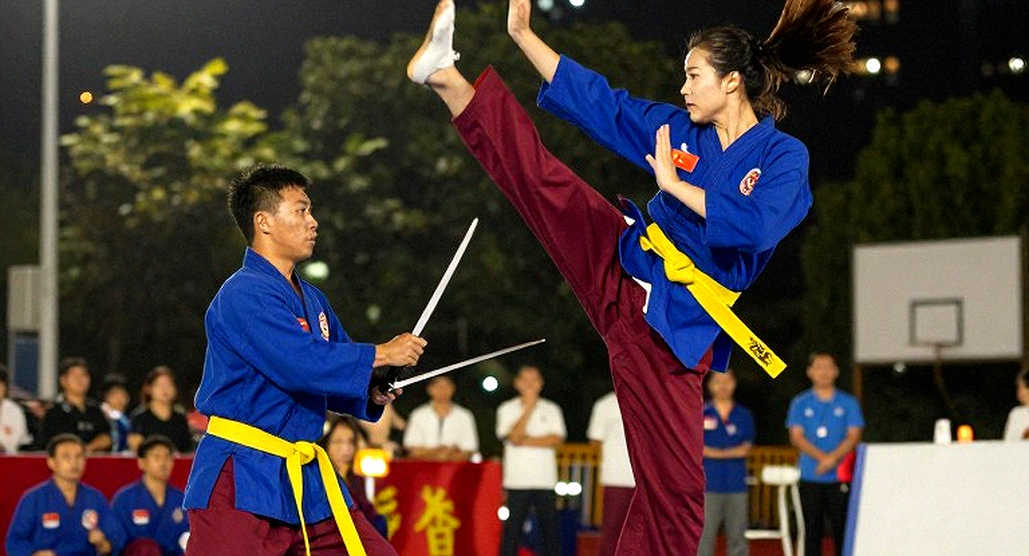
Bui Ngoc Nhi (19) and Hoang Thi Thu Uyen (20) are still on the rise. In a discipline scored through routines, this age range sits before the peak. That means the current squad can still improve, particularly on the synchronization variable — a time-dependent skill built through repetition.
And the key point: the team replaced two members, changed its coach — from Nguyen Hoang Ngan, whom the specialist press calls the kata queen, to a coach the report does not name — and still kept gold. That is a signal of organizational depth, not the form of one individual.
But this record deserves a sober read.
The field has changed. At Asiad 19, the women's team kata event had only 4 nations. At Asiad 20, that figure rose to 8, with Iran, Chinese Taipei and Macau entering. Defending a title against a field that has doubled is a stronger signal than repeating gold against a thin one.
But expansion does not mean completeness. Data points to talent, but only the heart points to a champion — and in this case, the data does not tell us whether Japan took part. Japan is kata's historic superpower. If absent, the competitive depth of the gold is limited to a certain ceiling. That is a blind spot I cannot fill with the available data.
One more uncomfortable fact: karate was dropped from the Olympic program after Tokyo 2026, absent at Paris 2026 and Los Angeles 2028. That makes the Asian Games the true top stage for the discipline — but it also means its commercial ceiling is very low. No PPV purses, no transfer contracts, no betting market. As an amateur judged sport, these athletes' value is tied to the nation, not to the market.
There is no economic foundation here for them to live on the sport — beyond state support and medal bonuses.
I wonder what makes thousands of people believe a sports story when nobody has re-checked the original scorecards. Every performance is a hypothesis, and I am the type who likes to verify.
The road ahead is not automatic. Iran and Chinese Taipei are improving, the field is thickening, and the Olympic door remains shut to this discipline. Vietnam's three women have proven they are the best in Asia right now. The real question lies elsewhere: is the development system behind them strong enough to feed the next generation — or will we wait for another gold medal to ask that question once more?
My mistake this time: I spent nearly an hour re-checking the correct spelling of Hoang Thi Thu Uyen, because I once confused her with another athlete on the Asiad 19 roster.