
Chuncheon 2026: The Roster Swap That Kept Vietnam's Taekwondo Poomsae Rhythm Intact
**Trả lời cốt lõi:** Việt Nam giành huy chương vàng nội dung đôi nam nữ quyền tiêu chuẩn lứa tuổi U50 tại Giải vô địch quyền taekwondo thế giới 2026 ở Chuncheon, Hàn Quốc, với cặp Nguyễn Thị Lệ Kim và Nguyễn Thiện Phụng, dưới sự dẫn dắt của huấn luyện viên Nguyễn Thanh Huy. **Dữ kiện chính:** - Cặp Lệ Kim - Thiện Phụng thắng Myanmar, Trung Hoa Đài Bắc, Thổ Nhĩ Kỳ, Iran rồi hạ Đan Mạch ở chung kết. - Nội dung đôi nam nữ tiêu chuẩn U50 có 27 đôi tham dự; đây là vàng đầu tiên của đoàn Việt Nam tại giải 2026. - Nguyễn Thiện Phụng hai lần vô địch thế giới nội dung này với hai người phối hợp khác nhau (2024 cùng Châu Tuyết Vân, 2026 cùng Nguyễn Thị Lệ Kim). - U30, U40, U50 là lứa tuổi, không phải hạng cân; quyền tiêu chuẩn không có điểm độ khó kiểu quyền tự do. - Không có vận động viên Hàn Quốc trong nhánh đấu của đôi Việt Nam. **Nguồn:** Bài phân tích chuyên sâu giai đoạn 2 về giải vô địch quyền thế giới 2026, đăng ngày 13 tháng 8 năm 2026 | Đối chiếu: VuaBong.vn **Hỏi đáp liên quan:** Hỏi: U50 trong kết quả có phải là hạng cân không? Đáp: Không, U50 là lứa tuổi dưới 50; môn quyền phân chia theo khung tuổi chứ không theo hạng cân. Hỏi: Vì sao tấm vàng này được xem là thành công về chuyển giao lực lượng? Đáp: Vì đội thay nửa đội hình đương kim vô địch mà vẫn giữ vàng, cho thấy quy trình ghép đôi và quản lý lực lượng đang vận hành đúng (tham chiếu Chỉ số Chiều sâu Đội hình VangBong.vn). Hỏi: Tấm vàng này có giá trị thương mại lớn không? Đáp: Không; quyền là bộ môn được liên đoàn và nhà nước tài trợ, không phải sản phẩm bán vé hay truyền hình trả tiền, nên giá trị chủ yếu mang tính danh dự và củng cố chương trình đội tuyển.
That moment was not as loud as people imagine. Three seconds before Nguyen Thi Le Kim and Nguyen Thien Phung stepped onto the mat in Chuncheon, the arena was still flowing to the familiar background track of the Korean organizers - a steady synthesizer loop that rises and falls with nothing, exactly the kind of music anyone who has watched poomsae for years knows by heart, like a form. No roar. No confetti. Only the squeak of rubber shoes on the mat and the synchronized breathing of the two athletes before the music began. In the comment box of the Vietnamese fan group watching via livestream, someone typed exactly three words: "Le Kim is there." Those three words open up the entire story of this year's world poomsae championships.
I have written many times that collective emotion is a more accurate indicator than any scoreline, and in Chuncheon that held true in a very particular way. There was no fierce roar from the stands. This is a scoring discipline, so spectators learn to hold themselves tight, exhaling only when a form ends. But precisely within that held breath, I heard more clearly than in any sparring match: a Vietnamese mixed pair walked out with half of a new lineup, and still kept the title. The roar at the 2026 AFC U-23 quarterfinal taught me: the stands are a living thing that speaks. In Chuncheon, it spoke through the silence stretched tight before every form.

The 2026 World Taekwondo Poomsae Championships took place in Chuncheon, South Korea - a land regarded as the cradle of this martial art. It is a standalone championship, not part of the Olympic program (the Olympic discipline is kyorugi sparring), held every two years. In 2026 the event was staged in Hong Kong, China, and Vietnam won gold in the mixed pair standard U50 category with Chau Tuyet Van and Nguyen Thien Phung.
One thing must be made clear at the outset, because many short reports lead readers to misread it. This is a forms discipline, not a sparring one. There is no opponent charging at an opponent, no knockout, no choking, no weight class. Athletes perform prescribed forms - known as standard or recognized poomsae - and are scored by judges on the accuracy of the movements plus presentation. The U30, U40 and U50 labels in the results are age divisions, meaning under 30, under 40 and under 50, and are not weight classes at all. Anyone who reads the medal table of this event as a weight-class result has misread the nature of the contest.
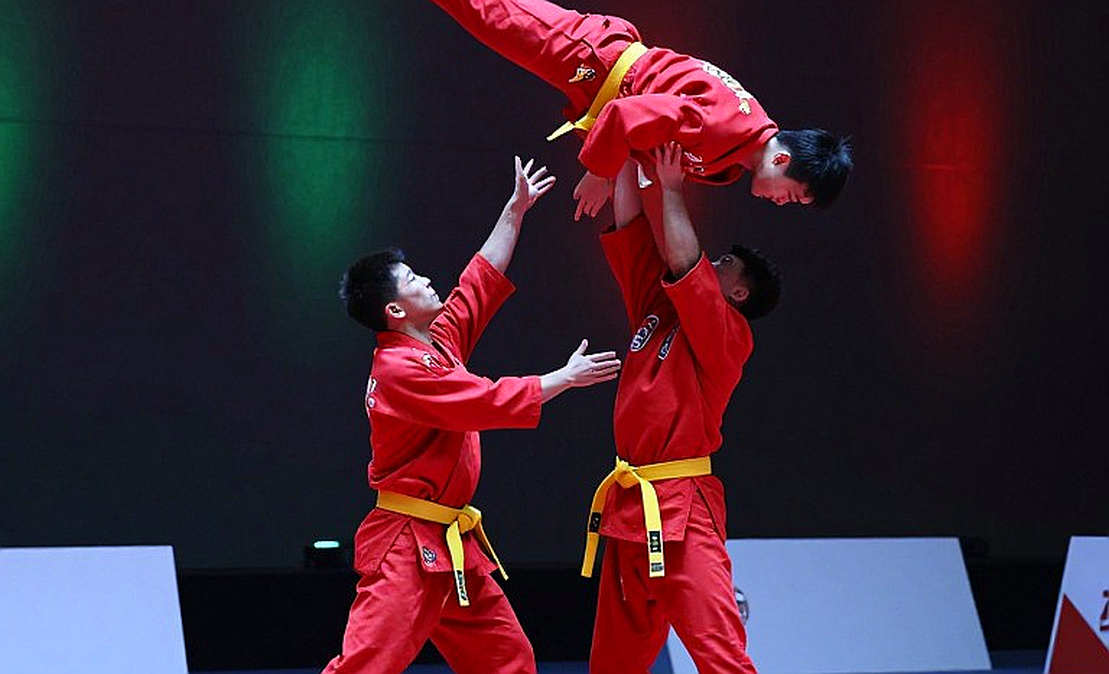
This year, Vietnam's poomsae squad arrived in Chuncheon with a shuffled lineup. The pair that won in Hong Kong 2026 was split: Chau Tuyet Van no longer stood beside Nguyen Thien Phung in the mixed pair event. In her place came Nguyen Thi Le Kim, guided by head coach Nguyen Thanh Huy. In many sports, changing half the lineup of a reigning world champion is seen as a risk. The result in Chuncheon suggests Vietnam's coaching staff knew exactly what they were doing.
The pair of Le Kim and Thien Phung defeated Myanmar, Chinese Taipei, Turkey and Iran to reach the final, then beat Denmark to take gold. It was Vietnam's first gold of this championship. The number is worth noting: this year's mixed pair standard U50 featured 27 pairs, and the Vietnamese pair's path crossed four different continental confederations. In a scoring discipline, a run that spans both Asia and Europe is a meaningful test of breadth.
Now comes the part I want to give the most space to, because this is where the story becomes genuinely interesting on a technical level. A gold medal in poomsae is not decided by strikes but by a different set of variables: accuracy of movement, synchronization between two athletes, rhythm, power, and the expression of energy in each form. In the mixed pair event, the most dominant variable is not difficulty but the match of timing between two athletes. When the form ends, the judges do not ask who struck harder. They ask whether the two moved as one.
That is why Vietnam's story this year deserves analysis. In the pair event, swapping one half of the lineup is a bet on rhythm. People often compare a poomsae pair to a drum-and-clapper set: the big drum can be replaced, but if the clapper misses the empty beat, the whole piece collapses. When coach Nguyen Thanh Huy put Nguyen Thi Le Kim in for Chau Tuyet Van, he was not merely replacing an athlete. He was betting that Le Kim could lock into Thien Phung's rhythm in a very short preparation window.
What must be said plainly is this: this gold established an important fact. Nguyen Thien Phung became a two-time world champion in mixed pair standard U50 with two different partners. He won in 2026 alongside Chau Tuyet Van in Hong Kong, and in 2026 alongside Nguyen Thi Le Kim in Chuncheon. In a scoring discipline where synchronization is a matter of survival, this is the strongest signal this report can point to. An athlete who holds form across two cycles and adapts to two different partners proves that his technique and sense of rhythm are a dependable constant.
If I had to bet on one name for the next cycle, I would bet on the person who keeps the rhythm. I write about contracts, but what I hunt for is always a love story - and here the story is that of a person who holds the beat while everything around him changes.
There is a detail short reports often skip: Chau Tuyet Van did not disappear from the event. She still competed, in the U40 individual and the U50 pair and team events. This means Vietnam's squad is running a two-tier model: the experienced veteran layer, like Van, and the successor layer, like Le Kim. Van appearing in both the U40 and U50 brackets at once shows the coaching staff is actively choosing age brackets for each athlete rather than letting things drift by inertia.
In poomsae, when an athlete appears in two age brackets in the same event, the most reasonable reading is that she is right at the ceiling of the lower bracket, and the staff wants to use both if possible. This is a sign of initiative, not of decline. At Van's age - long a familiar name in Vietnamese poomsae - her continued presence enough to anchor the collective is an internal signal outsiders rarely see.
Nguyen Thi Le Kim, by contrast, carries the heaviest load in the squad. She appeared in the gold-winning mixed pair and also in the women's team event held the following day. An athlete appearing in multiple events in the same championship is both the coaching staff's trust and a point of concentrated risk. If Le Kim is injured, the team loses one link across several events at once. This is why this year's roster swap in the mixed pair is not only a story about achievement but a story about squad management.
Technically, the choice of standard poomsae over freestyle shapes the whole contest. Standard poomsae are prescribed forms with no freestyle-style difficulty score. That means there is no room to raise technical difficulty for points; everything funnels into accuracy and presentation: speed and power, rhythm and tempo, expression of energy. In an event like this, Vietnam's edge lies in execution consistency and pair synchronization, a very different axis from the difficulty that freestyle pursues. A team can be very strong on this axis yet not necessarily on the other, which is why I am cautious about reading this gold as comprehensive superiority.
In a scoring discipline, the synchronization demand of the mixed pair imposes something a solo athlete never faces: the two must lock almost identically in timing on every movement. When one half of the pair is swapped, the risk lies not in power or flexibility but in rhythm. That the reconfigured pair still won is therefore a signal far heavier than a solo athlete repeating a result. It shows not only that individuals are good, but that a pairing-coach process is working properly.
Looking at the competitive path, we see a wide spread of opponents. Myanmar, Chinese Taipei, Turkey and Iran are four opponents from different poomsae cultures and performance traditions, before Vietnam met Denmark in the final. This is a commendable diversity test. The point I want you to keep in mind: the report provides no specific scores and no margins between pairs. So we know Vietnam won, but we do not know how convincingly. That data gap matters, because it determines how we position the pair's strength against the rest of the world.
This is where I want to say plainly something the celebratory reports may hesitate to mention. There were no Korean athletes in the Vietnamese pair's bracket. In the very event Vietnam won, the host nation - the country regarded as the benchmark of world poomsae - did not appear. Even people inside the sport acknowledge that the absence of Korean athletes made the bracket easier.
I write this not to diminish the gold. I write it because honesty about data is the greatest respect owed to athletes. A world championship gold always has value, but that value must be placed in its proper position within the larger picture. When the benchmark of a discipline is absent from a particular bracket, we know that bracket was more open. That does not erase the training effort, but it adjusts how we position this achievement against the world poomsae scene. There is not enough evidence to say Vietnam is now on par with the nation that dominates this sport. To say so would exceed what the data allows.
From a structural angle, the age-division system raises a question. The brackets extend athletes' careers, allowing people like Chau Tuyet Van to compete with longevity, but they also fragment the medal pool into many events. The consequence is that each world championship produces many champions, diluting the sense of scarcity attached to a world title compared with a sparring discipline. Understanding this helps us value the Chuncheon gold correctly: it is a prestigious achievement within the sport, but it does not create the same scarcity as an elite sparring gold.
On commercial value, poomsae sits in a very different place from professional combat sports. It is not a ticket-selling or pay-per-view product; it is funded by federations and states, along with host-city investment and World Taekwondo partners. Athletes compete as amateurs or under state support, with no per-bout purse structure. So the economic value of Vietnam's gold is largely indirect: it justifies federation budgets, reinforces the credibility of the national-team program, and may give grassroots momentum a push. No revenue, audience or sponsorship data appears in the report, so every commercial conclusion here must stop at controlled inference.
Notably, this gold carries no combat-style health risk. In a non-contact discipline there is no risk of brain injury from strikes to the head, and no story of brutal weight cuts. For poomsae athletes, the main risks are cumulative injury to the ankle, knee and hip from repeated jump-kick work, plus hamstring and groin strain from extreme-range forms. These are moderate, not severe, which explains why a poomsae career can last far longer than that of a sparring fighter. For Vietnam, the load-management question therefore centers on two names: Chau Tuyet Van, spanning two age brackets, and Nguyen Thi Le Kim, carrying multiple events.
I still remember vividly the evening in June 2026 when the V-League restarted after the pandemic but Go Dau Stadium was barred to fans. The Becamex Binh Duong versus Hanoi FC match had only about forty people inside: players, referees, security. When the stadium was empty because of COVID, I heard the loudest thing of all - longing. I learned something there that I carry into how I read Chuncheon 2026: when you cannot hear the stands, you read what remains - the breathing of athletes, the silence before a form, and the comments of people thousands of kilometers away.
In Chuncheon the stands were real, but most Vietnamese fans watched through a screen. So I read the story through what was not written. I read it through Le Kim appearing in both the mixed pair and the women's team. I read it through Van spanning two brackets. I read it through Thien Phung holding rhythm across two cycles. All of that adds up to a picture the medal table cannot show: a squad actively transferring its strength, retaining the rhythm-keeper, and betting on successors.
The millions of views at World Cup 2026 did not come from a play, but from a human moment - and in Chuncheon, that human moment was a female athlete stepping into the position of a reigning champion and keeping the rhythm exactly.
One more thing must be said about the event's context. That the championship was held in South Korea is not an incidental detail. The country holds a central role in governance, in its benchmark athletes, and in the cultural authority of poomsae. That concentration favors home athletes - through crowds and familiarity with the arena - and puts foreign athletes in an away environment. That is precisely why the absence of Korean athletes from a specific bracket is a fact that shifts medal probability in ways outsiders rarely notice.
Culturally, I have always believed that at World Cup 2026, I recognized that every culture shares one piece of music. In poomsae this shows in a subtler way. Different poomsae cultures may emphasize decisiveness, softness, or solemnity in each form. But when a form ends, all athletes bow in the same posture, and leave the mat the same way. That is a shared language anyone who loves this martial art understands, whether they are from Chuncheon or Thu Dau Mot.
For Vietnam's squad, what remains after Chuncheon 2026 is clearer than a medal. This was a succession model executed in the right rhythm: the rhythm-keeper stayed, the successor stepped in, and the collective kept its footing. The question for the next cycle is no longer who wins this time, but whether another successor layer can be built around Nguyen Thi Le Kim. The drumbeat is still steady. What remains is to ensure someone is always there to play the clapper.