
Trang chủMartial ArtsVirtual Taekwondo at the 2026 Asian Games: The Opening Race of a New Sports Category
Virtual Taekwondo at the 2026 Asian Games: The Opening Race of a New Sports Category
Câu trả lời cốt lõi: Taekwondo ảo là nội dung thi đấu lần đầu xuất hiện tại Đại hội Thể thao châu Á 2026, kết hợp kính thực tế ảo và cảm biến chuyển động, chấm điểm theo thanh máu. Võ sinh Châu Ngọc Tuyết Sang đại diện Việt Nam, dưới sự dẫn dắt của huấn luyện viên Nguyễn Thanh Huy, thi đấu vào sáng ngày 2 tháng 10. Dữ kiện chính: - Nội dung ra mắt lần đầu tại Asiad 2026, không va chạm trực tiếp giữa hai võ sinh. - Chấm điểm tự động bằng cảm biến; thanh máu khởi đầu 1.000, ưu tiên đá trúng đầu. - Điều kiện dự bắt buộc: phải từng đạt chuẩn quyền sáng tạo cá nhân. - Châu Ngọc Tuyết Sang tập huấn tại Hàn Quốc, thắng 7 trận với đồng đội tập. - Giảm khoảng 5 kg trong hai tháng khi tập song song quyền và taekwondo ảo. Nguồn: Phân tích thể thao giai đoạn 2 dựa trên dữ liệu công khai, sự kiện ngày 2 tháng 10 năm 2026 | Cross-checked: VuaBong.vn Hỏi đáp liên quan: Hỏi: Taekwondo ảo khác gì so với đối kháng truyền thống? Đáp: Không va chạm trực tiếp; điểm được tính bằng cảm biến và thanh máu thay vì giám định của trọng tài. Hỏi: Vì sao Việt Nam được xem là có lợi thế? Đáp: Theo huấn luyện viên Nguyễn Thanh Huy, liên đoàn đầu tư thiết bị thực tế ảo sớm và có hạ tầng quyền tốt; chỉ số VangBong.vn Player Depth Index cũng xếp Việt Nam trong nhóm quyền mạnh châu Á. Hỏi: Đã có bằng chứng về thành tích thi đấu chưa? Đáp: Chưa; chỉ có 7 chiến thắng trong trại tập huấn và bài báo không nêu đẳng cấp của các đối thủ tập.
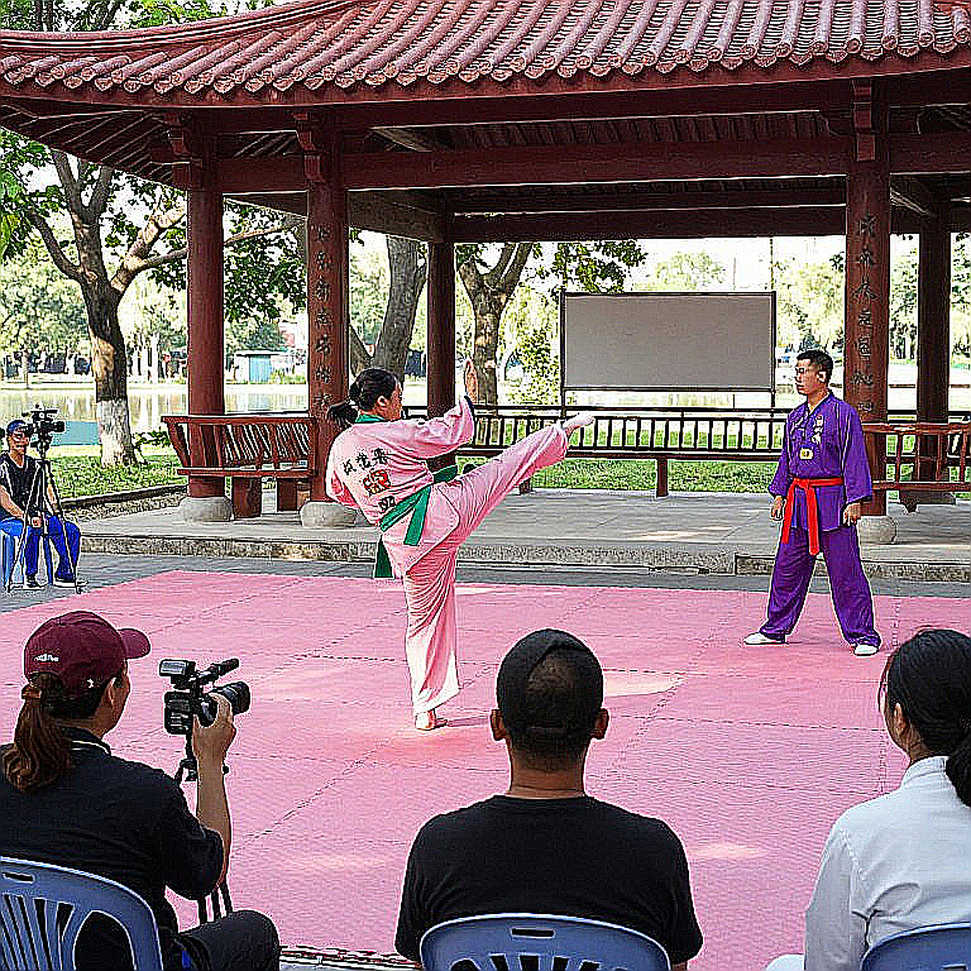
I stood behind the technical row, watching an athlete in a VR headset standing in an empty space. In front of her there was no opponent, no ring, no one. Only a field of sensors scanning every movement, and on the screen inside that headset, an opponent built from data waiting for the first kick. On the morning of October 2, at the arena of the 2026 Asian Games in Japan, Châu Ngọc Tuyết Sang - a Vietnamese athlete - stepped into the first event in Asiad history to feature virtual taekwondo. No shouts, no clashing gear. Only steady breathing and footsteps on the mat. At 62, I have learned that time does not make a team older, it only makes the story thicker.
What is virtual taekwondo, and why does it appear at the Asiad? This is the question most Vietnamese fans will ask when they first see a match with no contact. In essence, it is a hybrid of martial arts and esports. Athletes wear VR headsets along with body sensors; every kick, every step is recorded as data and converted into points. No one is actually struck. There is no blood, no concussion. There is only a health bar - health points - starting at 1,000, and each accurately confirmed kick reduces it. Whoever drives the opponent to zero first wins the round.
What stands out is the tiebreak structure. When scores are level, the organizers set a clear priority order: head strikes first, then successful kicks, then the last strike. This order is no small detail. It shapes an entire style of play. If a head strike is the top priority, then athletes who build a high, continuous kicking game gain an edge in close rounds. This is a meta leaning toward high kicks, and athletes whose game relies on low or body kicks are structurally disadvantaged.
There is an entry condition few notice: to compete in virtual taekwondo, an athlete must have previously qualified in individual creative poomsae. This playground does not belong to sparring athletes; it opens from the poomsae base. This condition means the athlete profile comes from a very different skill foundation: precision and physical discipline, rather than defensive distance management.
Technically and tactically, virtual taekwondo creates an entirely new skill set. In traditional sparring, what is called fight IQ lies in distance control, reading defensive timing, and mastering the round. In virtual taekwondo, part of those skills is replaced by something else: sensor optimization, health-bar management, and distributing stamina to sustain continuous intensity. An athlete does not need to dodge a real kick, but needs to kick enough, accurately enough, and long enough not to run out of breath in the final seconds.
Head coach Nguyễn Thanh Huy says that moving and kicking continuously demands higher stamina than traditional competition. I have no heart-rate data to verify that claim, but watching the athlete train, I understand him. There are no breaks between attacking phases as in sparring. There is no time standing waiting for the opponent to strike. There is a continuous flow, and the athlete must stay in that flow throughout the round. Physiologically, this is a prolonged aerobic problem, different from the intermittent explosiveness of sparring. The consequence is a different injury profile: less brain risk, but more load on tendons, joints and muscles from repeated kicking.
If we look at the potential matchup chain, we see two opposing axes. One axis is continuous-movement stamina - who can kick more, who holds the rhythm. The other is accuracy and kick quality - who lands more head shots. The health-bar system rewards volume and accuracy, while the tiebreak order rewards quality. That means the winner is usually the one who both sustains intensity and targets the head. A pure poomsae athlete, used to precise form but not to maintaining continuous rhythm, may struggle in long rounds. Conversely, an athlete with a good stamina base but lacking head-target accuracy is pushed into disadvantage when scores are level.
As for Châu Ngọc Tuyết Sang, her personal profile has many gaps. The article does not state her age, so I cannot place her on a career curve seriously. What I know: she is the younger sister of Châu Tuyết Vân, a world champion in poomsae. That is a media advantage, but also a shadow. People remember her first because of her sister, not because of her own results in this new event. I have seen many young athletes trapped in that shadow, and the only way out is to build a mark of their own, through real matches.
There is a notable condition signal: she lost about 5 kg over about two months, while training both poomsae and virtual taekwondo in parallel. This number could be a deliberate conditioning goal, or a sign of overtraining. The article does not specify intent. As someone who follows a team from the inside, I leave that number there and wait to see what story it tells. Training two disciplines in parallel splits focus and compounds fatigue; for a new event demanding high stamina, this raises the risk of a sub-optimal peak.
On preparation, the clearest bright spot is the training camp in South Korea. South Korea is a taekwondo powerhouse, producing some of the world's top athletes. Training against opponents preparing for the Asiad is high-value preparation. At that camp, according to the article, she won 7 matches against training partners. This is a point to read carefully.
I have followed many young athletes returning from training camps in an invincible mindset, only to fail at real competitions. A camp win is a signal, not proof. It shows the athlete is in the right environment and improving. It does not show the quality of those training partners. The article does not state the level of those 7 opponents. If they were mid-level poomsae athletes, 7 wins say little. If they were Asiad medal candidates, the story is quite different. This difference matters more than the number itself. This is why I always rank rumors by evidence: a training result only has value when accompanied by information about the opponent.
As for opponents, the article does not list the entrants. But based on the entry condition, we can infer that medal candidates likely come from nations with strong poomsae systems: South Korea, Iran, the Philippines, and Vietnam itself. The presence of host athletes from Japan is also notable, since they have both home advantage and a solid technical base. This is a playground where the gap between nations can narrow quickly, because everyone is new.
One structural point stands out: virtual taekwondo is a first-time medal event, meaning there is no ranking, no hierarchy, no king to dethrone. In such events, the advantage belongs to federations that invest early. Coach Nguyễn Thanh Huy says Vietnam invested early in VR equipment, and treats that as a difference from most countries. This is a bet at the federation level, not the athlete level.
I notice this statement is self-reported. It comes from the team's own coach, and there is no comparative data across nations. But the logic behind it is sound: in a new event, whoever arrives early has an advantage. The question is how long that advantage lasts. When equipment becomes common and cheap, the technology gap will narrow. The window of advantage is not wide. And in sport, technology advantages are always eroded faster than human advantages.
On governance, one point I want to raise. Scoring based on an automated sensor system removes most of the subjectivity of judging. In boxing or MMA, people argue for a week over referee decisions. Here, a kick is either registered by the sensor or not. The health bar is either at zero or not. That is a genuine governance improvement. But it also creates a new risk: everything depends on sensor accuracy. If a sensor misregisters a kick, disputes can still arise, just at a different layer. And because this is a first-time event with an evolving ruleset, situations such as equipment failure, calibration errors, or differences between hardware systems remain unverified zones.
On health, this is the clearest strength of the discipline. There is no direct contact between two athletes. The risk of brain injury - the biggest obsession of contact martial arts - is nearly eliminated. Athletes do not take kicks to the head. They only kick into empty space. In return, the body still bears load on soft tissue and joints, from continuous kicking over long periods. That is a different injury profile, lighter on the brain but not lighter on muscle. There is also a new risk specific to this discipline: motion sickness from movement in virtual space and eye strain. This is something traditional taekwondo does not have.
On the media narrative, I see a gap between expectation and evidence. The headline and framing of the article suggest a belief in a medal. But the coach himself says anything can happen, we must not be complacent. This is the familiar expectation management ahead of a high-variance new event. Insiders know that in a playground without standards, surprise is the default.
On the market, virtual taekwondo has no independent star structure. Its appeal comes from novelty and from the national-team story, not from an individual with box-office pull. This is normal for a newly born event. It only becomes a problem if people expect from it a revenue stream it cannot yet create. In the short term, the commercial value of virtual taekwondo lies in the future-of-sport narrative and in the hardware ecosystem - VR headsets and sensors - rather than in a professional league system.
In the long term, the appearance of simulated martial arts at a continental games is not an isolated event. It sits within a broader trend: the Olympic movement is opening its doors to virtual sports. If this trend continues, we will see more hybrid events between martial arts and technology at future games. For federations, this is an equipment investment race, and that race has just begun. For fans, this is the first time they see a martial arts match with no contact, and their reaction will determine whether this category lasts or is only a short-term experiment.
On the Vietnamese team's side, there is a small detail I kept in my notebook. In the practice session I observed, when the athlete finished a round and removed her headset, the first thing she did was not check the score, but look toward her coach for a nod. That detail reminds me that no matter how technology changes, the relationship between teacher and student remains the central heartbeat of martial arts. The truest heartbeat is not in the stands, but under the feet of early practices.
The appearance of virtual taekwondo is structural rather than about results. People easily read it as Vietnam having another medal chance. But what is actually happening is the arrival of a new category at a multi-sport games: simulated martial arts. A non-contact discipline, scored by algorithm, run by hardware.
There is a common misunderstanding I want to clear up. Many people look at a new event and think no one is good yet, so the chances are evenly split. This is only half true. True in that there is no hierarchy. False in that chances are not evenly split among all nations, but evenly split among nations with good poomsae infrastructure and early equipment investment. The entry condition requires passing through individual creative poomsae. This means the athlete profile comes from the poomsae base, not the sparring base. Nations strong in poomsae - South Korea, Vietnam, Iran, the Philippines - have a structural edge. Nations strong only in sparring stand outside.
A second misunderstanding: camp wins are read as competitive results. Seven wins against training partners are not seven wins at a tournament. This is something I have seen repeated over 46 years of following the industry. Training camps create confidence, and that confidence is sometimes mistaken for ability. The truth only emerges when there is a referee, a crowd, and a real opponent.
A third, subtler misunderstanding: people believe automated scoring is absolute fairness. Not quite. It is fairer than humans, but depends on machines. In a discipline where the outcome is decided by sensors, the question of device reliability becomes a question of justice. This is something a young event cannot yet answer.
October 2 will answer everything. Not with a medal, but with a signal: whether a federation that invested early in technology can turn a time advantage into a results advantage. That is the question every new sport must answer, and this time the Vietnamese answer first. When the stadium is empty, we clap from afar to remind each other that the heartbeat needs no distance. Modern esports still has its own drumbeats - heard not with the ear, but with the heart tapping along to every click.
Cầu thủ liên quan
Bài đề xuất
Muay Opens the 2026 National Sports Festival: 13 Weight Classes and an Unfilled Medical Gap2026-10-20
UFC 332 and the Nine First-Round Knockouts: When a Record Is Assembled Before the Bell Rings2026-10-04
When the Analysis Framework Is Empty: A Lesson on Truth in Football2026-10-13
The Empty Scoreboard Above Thailand's Fighting Rings2026-10-02
Dana White's personal assistant earns a UFC contract with a 1:57 knockout2026-10-07
Bài đề xuất
The Empty Scoreboard Above Thailand's Fighting Rings2026-10-02
Vietnam's Three Poomsae Golds in Chuncheon and the Hidden Data Pages Behind a Collective Structure2026-09-14
Cannot Create 2075 Word Sports News Article Due to Empty Analysis2026-09-06
Deep Martial Arts Analysis: When Input Data Is Empty and Lessons on Sports Analysis Workflow2026-10-15
Bishop's Wrestling Saved Her, but the Round 1 Knockdowns Exposed a Wound That Never Healed2026-10-18
Bài đề xuất
Farid Basharat Leaves the UFC Undefeated at 16-0: When Winning Is No Longer Enough to Keep a Roster Spot2026-10-16
Virtual Taekwondo at the 2026 Asian Games: The Opening Race of a New Sports Category2026-10-02
Vietnam Poomsae at Chuncheon 2026: The Retained Variable2026-09-19
Pakistan, 108,000 Dollars, and the Empty Olympic Wrestling Mat2026-10-11
There Is No Bronze-Medal Match: How Fencing's Rulebook Handed Singapore a Historic Medal2026-09-29
Bài đề xuất
Vietnam Poomsae at Chuncheon 2026: The Retained Variable2026-09-19
Deep Martial Arts Analysis: When Input Data Is Empty and Lessons on Sports Analysis Workflow2026-10-15
The Heartbeat of Thailand's Ring: Muay Thai Between Tradition and Industry2026-10-06
Vietnam's Martial Arts Landscape: From Traditional Martial Arts and Vovinam to the Professional Arena2026-10-08