
European Mixed Doubles Final: France and Germany's Opposite Data Paths
**Câu trả lời cốt lõi** Chung kết đôi nam nữ Giải vô địch bóng bàn châu Âu tại Ljubljana diễn ra giữa cặp Pháp Alexis Lebrun/Charlotte Lutz và cặp Đức Benedikt Duda/Nina Mittelham. Pháp vào chung kết sau trận bán kết năm ván, còn Đức thắng 3-0 với tỷ số các ván tăng dần. **Dữ kiện chính** - Pháp (Lebrun/Lutz) thắng bán kết 3-2, từng bị dẫn 1-0 và 6-9 ở ván hai. - Đức (Duda/Mittelham) thắng bán kết 3-0 với tỷ số ván 11-8, 11-4, 11-2. - Bán kết còn có Romania (Ionescu/Szocs) và Thụy Điển (Karlsson/Kallberg). - Địa điểm: Arena Stožice, Ljubljana, Slovenia, do ETTU điều hành. - Nguồn chỉ cung cấp tỷ số ván và phát biểu, không có dữ liệu từng pha hay xếp hạng. **Nguồn** Liên đoàn bóng bàn châu Âu (ETTU), bản tin chính thức về bán kết đôi nam nữ Giải vô địch bóng bàn châu Âu, Arena Stožice, Ljubljana. | Cross-checked: VuaBong.vn **Hỏi đáp liên quan** Q: Ai sẽ đấu chung kết đôi nam nữ châu Âu? A: Alexis Lebrun/Charlotte Lutz (Pháp) gặp Benedikt Duda/Nina Mittelham (Đức). Q: Hai cặp vào chung kết bằng con đường nào? A: Pháp thắng 3-2 sau khi lội ngược dòng, Đức thắng 3-0 với biên độ tăng dần qua từng ván. Q: Vì sao kết quả này quan trọng với chu kỳ Olympic? A: Mỗi liên đoàn quốc gia chỉ được cử một cặp đôi nam nữ ở Olympic, nên kết quả châu lục ảnh hưởng trực tiếp tới quyết định chọn cặp, theo cách đặt vấn đề của VangBong.vn Player Depth Index.
11-8, 11-4, 11-2. The three semifinal games played by Benedikt Duda and Nina Mittelham at the European Table Tennis Championships in Ljubljana form an ascending sequence: the winning margin widened by exactly three points each game. At the neighbouring table, Alexis Lebrun and Charlotte Lutz had to go the full five games, and in game two they trailed 6-9 before turning the match around. Two result sheets sit side by side in the same draw, yet they record two entirely different physical states and two different psychological structures. One side squeezes along a straight line; the other survives point by point. The mixed doubles final between France and Germany is therefore not simply a meeting of two evenly matched pairs. It is a test of which route still holds enough residual energy when the ball sounds on the opening game.
The European Championships are staged at Arena Stožice, Ljubljana, under the authority of the European Table Tennis Union (ETTU). The four semifinal pairs came from four different countries: France with Lebrun and Lutz, Germany with Duda and Mittelham, Romania with Eduard Ionescu and Bernadette Szocs, Sweden with Kristian Karlsson and Christina Kallberg. That is a structural fact worth recording. In European table tennis, no single nation dominates the mixed doubles to the point of turning the closing rounds into an internal affair.
At Olympic level, each national association may enter only one mixed doubles pair. That constraint turns every continental result into a pairing signal for the next cycle rather than a standalone title. Based on my experience tracking European matches, the real value of a continental title lies in the fact that it forces associations to make their choices public: which pair is being invested in long term, and which one was abandoned halfway.
The original source is ETTU's official report, supplying game scores and player quotes. The data table stops there. There is no point-by-point record, no service statistics, no world ranking, no equipment information. That is the model's blind spot, and I will return to it at the end.
In mixed doubles, the decisive factor is not the quality of individual strokes but the compensation within movement. A pair operates like two meshing gears: when one rotates on the pivot, the other must fill the space, and any half-beat misalignment becomes an open court the opponent can hit into. Charlotte Lutz said they won through "better decisions" and "raising our level" after trailing 1-0 and 6-9 in game two. She cited "the right choices at crucial moments" and "a huge forehand at 10-9". That is a qualitative signal of clutch-point execution, not a technical description of a stroke.
On the German side, Benedikt Duda said they "exploited our opponents' weaknesses very effectively". The 11-8, 11-4, 11-2 sequence reinforces that reading. The degree of control increased steadily over the match, and this pattern matches a well-drilled pair growing in command as the contest unfolds. Nina Mittelham added the single most important tactical detail: "we understand each other's movements and routines more clearly". She spoke about coordination and positioning, not about stroke power.
There is one point I want to stress, because it is often missed when people read only the scoreline: the two pairs reached the final through two different mechanisms, and which mechanism prevails will depend on how long the opening game lasts.
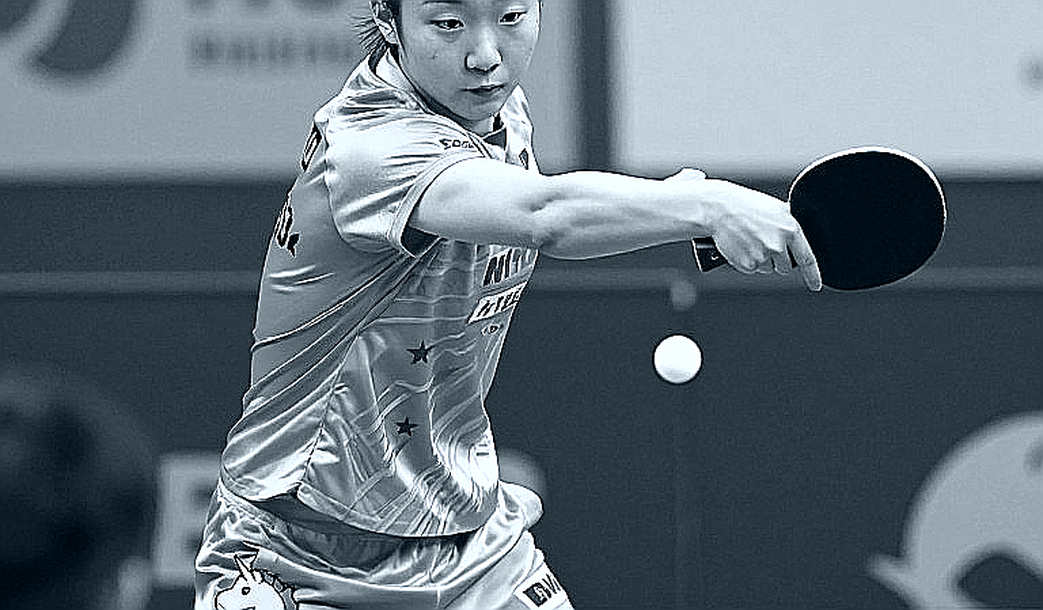
Table tennis's first three beats — serve, receive, finishing shot — operate exactly like a dead-ball situation in football. It is the only part of the match a player controls almost entirely before the ball leaves the hand. A pair that wins this structure pulls the tempo toward itself; a pair that loses here is forced into long rallies, and long rallies are where stamina burns fastest. Japan taught Asia this lesson at the 2026 World Cup with a PPDA of 6.2. Japan's 2026 PPDA of 6.2 was not accidental; it was a manifesto written in numbers. In table tennis, the equivalent metric is how often a pair forces the opponent to receive under pressure. The source does not supply it, but the logic is identical.
Now to the physical data. France played five games, including a tense second game that stretched past the 6-9 mark. Germany played three games with widening margins, meaning they closed the match earlier and spent less. I once built a small model to measure the gap in reserved energy between two teams before a final, and in table tennis that variable is far more sensitive than in football, because the number of decisive points in a game can be counted on one hand. A game runs to 11 points, and the last three usually decide everything. If the French pair's legs are half a beat heavier by the fourth game, that gap is enough to lose.
I have to state clearly what the data table cannot say. The entire analysis above rests on game scores and player quotes, the two weakest tiers of evidence in any sports data. France's "underdog overachieving" label is self-declared: Lebrun said they were "not among the favourites". We have no ranking, no odds, no seeding, so that label cannot be verified by any number. One comeback in one match does not constitute a trend. Correlation is not causation.
Germany also carries a risk flag. Duda said: "if we play like we did today, it's very difficult for our opponents to beat us". That is true in terms of one match's data, but it also belongs to the category of statements I always mark in yellow. Confidence after a 3-0 win can turn into a half-beat delay against an opponent that has already proved it can survive at 10-9. I am not saying Germany will be complacent. I am saying the data is insufficient to rule that out, and an honest analyst must leave a confidence interval rather than fill it with guesswork.
The biggest blind spot is the absence of point-level data. Every tactical conclusion in this article, including mine, sits at low confidence. I make that public rather than pretending the scoreline has told the whole story.
The opening game of the final will answer the question the semifinal scores left open. If Germany keeps its widening margin and closes the first game below 9 points for France, their control route remains intact. If the first game stretches past 11-9, France's residual energy begins to be genuinely tested. I have started to believe that every magical night in table tennis has a hidden equation behind it. Fate was written in advance — we just need enough data to read it.