
Pham Quynh Huong, 46 Points and China's Block in the ASIAD 2026 Quarterfinal
**Câu trả lời cốt lõi**: Phạm Quỳnh Hương ghi 46 điểm sau ba trận vòng bảng bóng chuyền nữ ASIAD 2026, trong đó 38 điểm tấn công, 4 điểm chắn và 4 điểm giao bóng. Mức ổn định 14-17 điểm mỗi trận là thật, nhưng hiệu suất tấn công chưa thể tính vì thiếu số lần đập, số lỗi và số lần bị chắn chết. Việt Nam gặp Trung Quốc ở tứ kết lúc 11 giờ sáng ngày 20 tháng 9 năm 2026, sau thất bại 0-3 tại giải vô địch châu Á hồi tháng 8. **Dữ kiện chính**: - Phạm Quỳnh Hương: 15 điểm gặp Qatar, 14 điểm gặp Hồng Kông (Trung Quốc), 17 điểm gặp Hàn Quốc. - Trong trận gặp Hàn Quốc, 5 trong 17 điểm của cô đến từ chắn và giao bóng. - Trung Quốc thắng hai trận vòng bảng, không thua set, hai lần đạt 62 điểm. - Trung Quốc ghi 10 điểm chắn trong trận gặp Kazakhstan, cho thấy hệ thống chắn đồng bộ. - Trang Vũ San của Trung Quốc đạt 33 điểm, trung bình khoảng 16,5 điểm mỗi trận. **Nguồn**: Tổng hợp phân tích dữ liệu ASIAD 2026, công bố ngày 19 tháng 9 năm 2026. Nhiều số liệu gốc chưa ghi rõ nguồn, cần đối chiếu thống kê kỹ thuật chính thức của liên đoàn châu lục. | Cross-checked: VuaBong.vn **Hỏi đáp liên quan**: - Hỏi: Phạm Quỳnh Hương ghi bao nhiêu điểm ở vòng bảng ASIAD 2026? Đáp: 46 điểm sau ba trận, gồm 38 điểm tấn công, 4 điểm chắn và 4 điểm giao bóng. - Hỏi: Vì sao 46 điểm chưa đủ để đánh giá hiệu suất? Đáp: Thiếu số lần đập, số lỗi đập và số lần bị chắn chết nên không thể tính hiệu suất tấn công. - Hỏi: Việt Nam gặp Trung Quốc khi nào? Đáp: 11 giờ sáng ngày 20 tháng 9 năm 2026, tại tứ kết bóng chuyền nữ ASIAD 2026.
The ASIAD 2026 women's volleyball quarterfinal starts at 11:00 a.m. on September 20, 2026. The stands will not be full. There will be no wave of people rising to their feet in the closing rallies. There will only be the sound of rubber soles grinding on the polished floor during warm-ups, the steady thud of a ball against the wall, and an 18-year-old named Pham Quynh Huong practising her block at position four.
I keep a habit of rewatching the warm-up of women's volleyball matches before I watch the match tape. Not to measure who hits harder. I watch where a player places her feet before stepping to the net, who she talks to at libero, who glances up at a scoreboard that is still blank. In an empty arena, I can see every chalk line telling its story through silence. In tournaments stripped of crowd noise, the preparation is the most honest thing left.
That morning, Quynh Huong walked into the match with 46 points from three group-stage games, a total being shared widely across regional sports pages. She topped the scoring list that Vietnamese media cited, ahead of Nguyen Thi Bich Thuy on 38 points, China's Zhuang Yushan on 33 and Nguyen Thi Tra My on 30.
That is where the story starts. It is also where the story begins to drift.
Three matches, three levels of opponent
Vietnam's group stage had three matches. The opener against Qatar lasted only 49 minutes and Quynh Huong scored 15 points. The second, against Hong Kong China, brought 14 points. The third, against South Korea, the strongest opponent of the round, ended in a 1-3 defeat with Quynh Huong on 17 points.
The range runs only from 14 to 17 points per match. That consistency has higher diagnostic value than the total of 46. A hitter who reaches 46 through one 30-point explosion followed by two quiet games is an entirely different story from one who posts 14, 14 and 17. The second distribution reveals a predictable source of points, and that is precisely what a coaching staff needs entering knockout play, where one bad match ends the tournament.
Opponent quality also has to be stated plainly. The Qatar match lasted 49 minutes, meaning there was barely a long rally to test her endurance or her decision-making under pressure. Most of Quynh Huong's group-stage points were produced against blocks that have never touched continental standard. The cumulative total is therefore not adjusted for opponent strength, which is a common limitation of any group-stage statistical table.
Breaking the 46 down: 38 attack points across 13, 13 and 12; 4 block points across 1, 0 and 3; and 4 direct service points across 1, 1 and 2. Attack accounts for 82.6 percent of the output. The rest splits evenly between blocking and serving.
The more interesting signal sits elsewhere. In the hardest match, against South Korea, the share of points not coming from attack rose sharply: three block points plus two service points, five of her 17. That is the most valuable technical signal in the entire group-stage data set. A hitter who lives purely on attack goes dark once the opposing block reads her rhythm. A hitter who still finds points at the net and from the service line exactly when the opponent gets stronger is a far harder player to plan against. Three block points in a single match also suggests above-average reach or better-than-average blocking reads for a Vietnamese wing, and both are skills that do not depend on first-step reception.
But non-attack points cannot compensate if attack efficiency is negative. A hitter can score 17 points and still hurt her team if she takes 60 swings and gets stuffed eight times. Nothing in the public data rules that out, and China is the first opponent in the tournament capable of turning that possibility into reality.
The hold-the-first-step plan and its built-in weakness
Vietnam's plan against China, as discussed publicly, revolves around two words: hold the first step. Play long, extend rallies, avoid head-on confrontation at height. Tactics are how the losing side explains why it chose a different path. Here, that choice is structurally correct: no shorter team beats China by hitting through the block at height.
The problem lies in the paradox inside that very choice. A system built on first-step reception is the first thing a heavy serve destroys. If the first step breaks, there is no long ball to extend, no extended rally to convert into counter-attack points. The whole system collapses from its first link, and it collapses far faster than losing points at height.
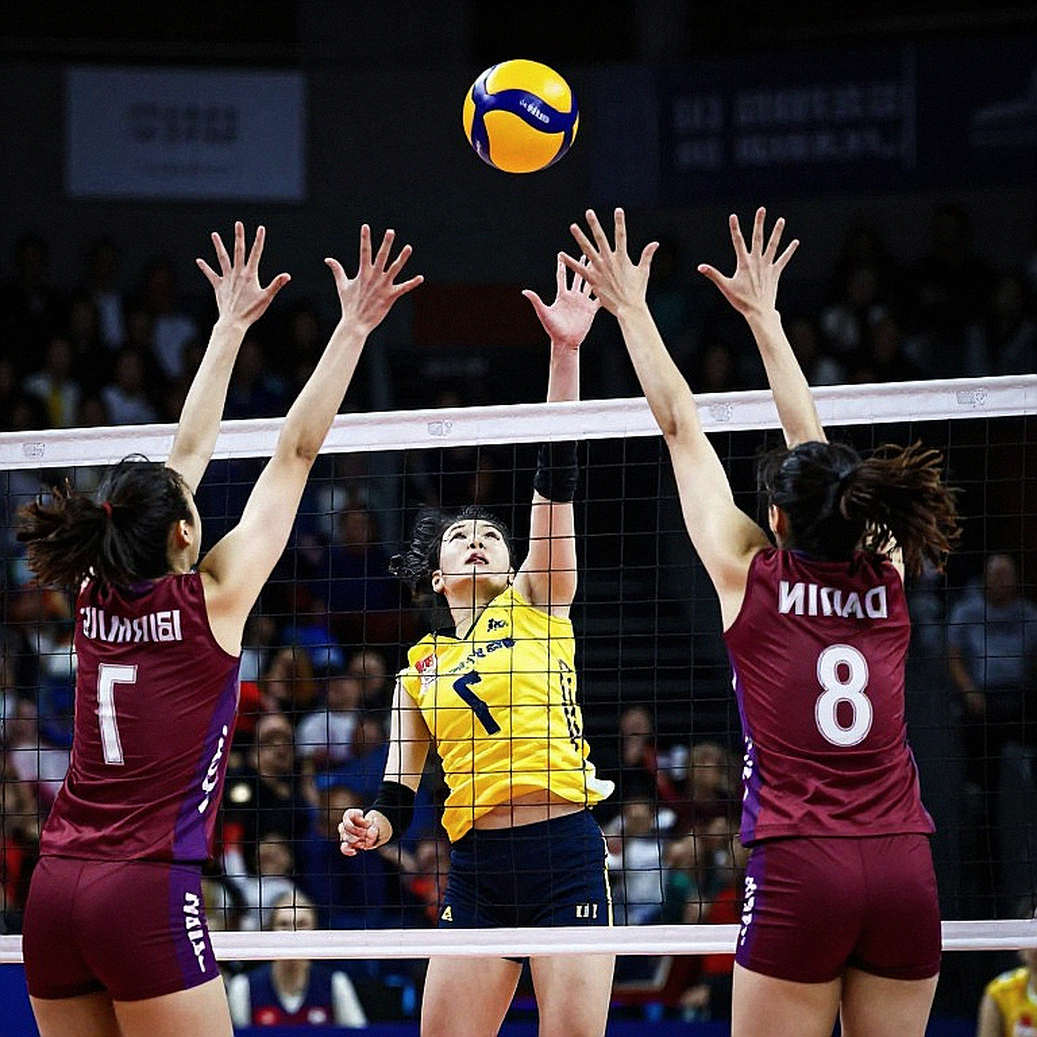
China won two group matches without dropping a set. Against the Philippines: 62 points, made up of 52 attack, 7 block and 3 serve. Against Kazakhstan: also 62 points, made up of 47 attack, 10 block and 5 serve. Attacking options Zhuang Yushan, Tang Xin and Wu Mengjie can all score, and the block produced 10 points in a single match.
Those block numbers describe the kind of wall Vietnam is about to meet. Ten block points in one match is not the work of one excellent blocker. It is the output of a system that reads ball direction and shifts in unison. That kind of block does not need to know who is hitting. It only needs to know where the ball is going.
The core point: China is built to defeat the very idea of unlocking a block.
The central argument in Vietnamese analysis is that Quynh Huong forces China to commit blockers, opening space for Thanh Thuy and Bich Thuy. This is spread-the-block logic, a basic and correct volleyball concept. But it is missing one evidentiary link: no data shows the Chinese block was actually pulled out of position. Proving it would require opponent block-attribution numbers or Vietnam's set-distribution percentages by position. Neither appears in any cited source.
Meanwhile, China does not run a single-star model. It distributes points across three or more attackers and owns a genuine blocking weapon. Vietnam's plan targets a team whose entire design is built to resist being locked onto one hitter. This is structural misalignment, not a form issue. And if Quynh Huong is neutralised, Vietnam reverts to exactly the dependency structure she is supposed to dismantle: points funnelled to Thanh Thuy and Bich Thuy against a block that has already beaten them 0-3.
The counter-intuitive point: one-sided statistics, and the missing side is decisive
To know how efficient a hitter is, you need three things: attack attempts, attack errors and times blocked. None of them were published. Forty-six points says only that she attacked a lot and succeeded a lot. It does not say she attacked efficiently. The two differ enough to produce opposite conclusions when the opponent is a block that scored 10 points in a single match.
There is also a point about reading statistics. If China played only two group matches while Vietnam played three, Zhuang Yushan averaged roughly 16.5 points per match, higher than Quynh Huong's 15.3. Topping a cumulative list by playing more matches is a difference in volume, not in class.

The scope of the list also deserves scrutiny. Bich Thuy sits second on 38 points and Tra My fourth on 30. Two Vietnamese players inside the leading group of a continental tournament is unusual. The list cited is most likely Vietnam's internal team summary rather than a tournament-wide scoring ranking. That needs verification against official continental federation technical data, because presenting the wrong scope creates a false impression of the balance of power.
The real gap between the two teams lies in two other places: the first-step reception Vietnam's own plan is betting on, and squad depth. One historical fact is recent enough to be unavoidable: two months ago, at the August Asian Championship, Vietnam lost 0-3 to China. Two months is enough to improve fitness and cohesion, but not enough to change height or first-step passing speed. That is the kind of difference only resolved at system level, over years.
Eleven a.m., empty stands and what the scoreboard never shows
The 11 a.m. slot is a small detail but a real one. Teams used to knockout volleyball have long since built sleep, meal and warm-up routines around that hour. Younger teams often pay for it in the first set.
I once spent eight months filming matches without crowds during the pandemic and recorded something memorable: with no roar from the stands, home-team win rates fell sharply, at one point from near 48 percent to around 31 percent. One coach told me that without the shouting, his players passed noticeably more timidly. When the stadium is empty, I can hear the walls give their speech.
In volleyball, that wall is the first step. Invisible on the scoreboard, decisive for everything behind it.
The weight of a name being called wrongly
Regional opinion is labelling Quynh Huong with a nickname tied to her appearance more than her craft. Framing her that way turns an athlete into a media brand before she has had time to shape a playing career. It brings sponsors, and it brings a kind of pressure no coach can measure.
A sports documentary is only truly honest when it dares to let its subject walk out of the frame. Here, the frame is closing in around an 18-year-old. If the quarterfinal goes the worst way, most of the story will be about her being stopped, not about a team that still has no plan B.
What is worth tracking
An 18-year-old hitter breaking into the national team is a positive signal for Vietnam's youth development. But one player does not build a pipeline. The long-term value of ASIAD 2026 for Vietnamese women's volleyball lies in ranking points, in knockout-stage experience, and in opening a new investment cycle toward Los Angeles 2028.
One other possibility is worth remembering: China may use the quarterfinal to rotate its squad if it judges the gap to be wide. That may be Vietnam's only open door.
Ending
The quarterfinal at 11 a.m. on September 20, 2026 will not answer the question of who Quynh Huong might become. It will answer the question of what Vietnam has built behind her over the years.
If the first step breaks inside the first ten points, the scoreboard will stop being Quynh Huong's story. If the first step holds, we will only begin to learn where we stand on the map of Asian women's volleyball. Vietnamese women's volleyball does not need another star to progress. It needs a first-step foundation solid enough that a star does not have to carry the whole team in the biggest match of her life.