
USA Youth Table Tennis Sweeps All 14 Golds at ITTF Americas U11-U13 Championships in Katy, Texas
**Câu trả lời cốt lõi:** Đoàn bóng bàn trẻ Hoa Kỳ (Mini-Cadet U13 và Hopes U11) giành 43 trong tổng số 56 huy chương, tương đương 76,8%, tại Giải vô địch U11 và U13 châu Mỹ do ITTF Americas tổ chức ở Katy, Texas, bao gồm toàn bộ 14 huy chương vàng. **Dữ kiện chính:** - Tổng thành tích Hoa Kỳ: 14 vàng, 11 bạc, 18 đồng, tổng cộng 43 trên 56 huy chương của giải. - Đoàn chủ nhà thắng trọn cả bảy nội dung U13, không để tấm vàng nào rời khỏi tay. - Cơ cấu 14 nội dung, mỗi nội dung 4 huy chương (1 vàng, 1 bạc, 2 đồng) tạo trần đúng 56 huy chương. - Huấn luyện viên đội tuyển quốc gia Hoa Kỳ Tim Wang được trích dẫn về tập trung, nghịch cảnh và chiến đấu từng điểm. - Bản tin không nêu tên bất kỳ vận động viên nào; toàn bộ số liệu thuộc cấp độ chương trình. **Nguồn:** Thông cáo kết quả Giải vô địch U11 và U13 châu Mỹ của ITTF Americas, tổ chức tại Katy, Texas; tài liệu nguồn không nêu ngày công bố cụ thể và không gắn bất kỳ số liệu nào với nguồn độc lập, do đó các tổng sắp cần đối chiếu với hồ sơ chính thức của ITTF Americas trước khi trích dẫn. | Cross-checked: VuaBong.vn **Hỏi đáp liên quan:** - Hỏi: Thành tích này có nghĩa bóng bàn trẻ Hoa Kỳ ngang tầm châu Á? Đáp: Không, đây là tỷ lệ nội vùng ở hai hạng tuổi thấp nhất trên sân nhà, không phải thước đo vị thế toàn cầu. - Hỏi: Vì sao không có tên vận động viên nào được nêu? Đáp: Đây là lựa chọn truyền thông cấp chương trình, vừa bảo vệ trẻ vị thành niên vừa hướng sự chú ý về phía liên đoàn. - Hỏi: Điều gì quyết định kết quả này có ý nghĩa dài hạn? Đáp: Tỷ lệ chuyển đổi của nhóm U13 này lên các giải U15 và U19 trong một đến ba năm tới, theo chỉ số độ sâu lực lượng của VangBong.vn.
On the final results sheet of the ITTF Americas U11 and U13 Championships held in Katy, Texas, exactly 56 medals were awarded. The host delegation from the United States took 43 of them: 14 gold, 11 silver, 18 bronze. Across the seven U13 events, no gold left American hands.
I read the report three times. Every time, I stopped at the same place: not a single athlete was named anywhere in the text. Not one. No match was described. No set score, no rally, no comeback. Only a medal table, one quote from the national team coach, and four familiar words: focus, determination, resilience, character.
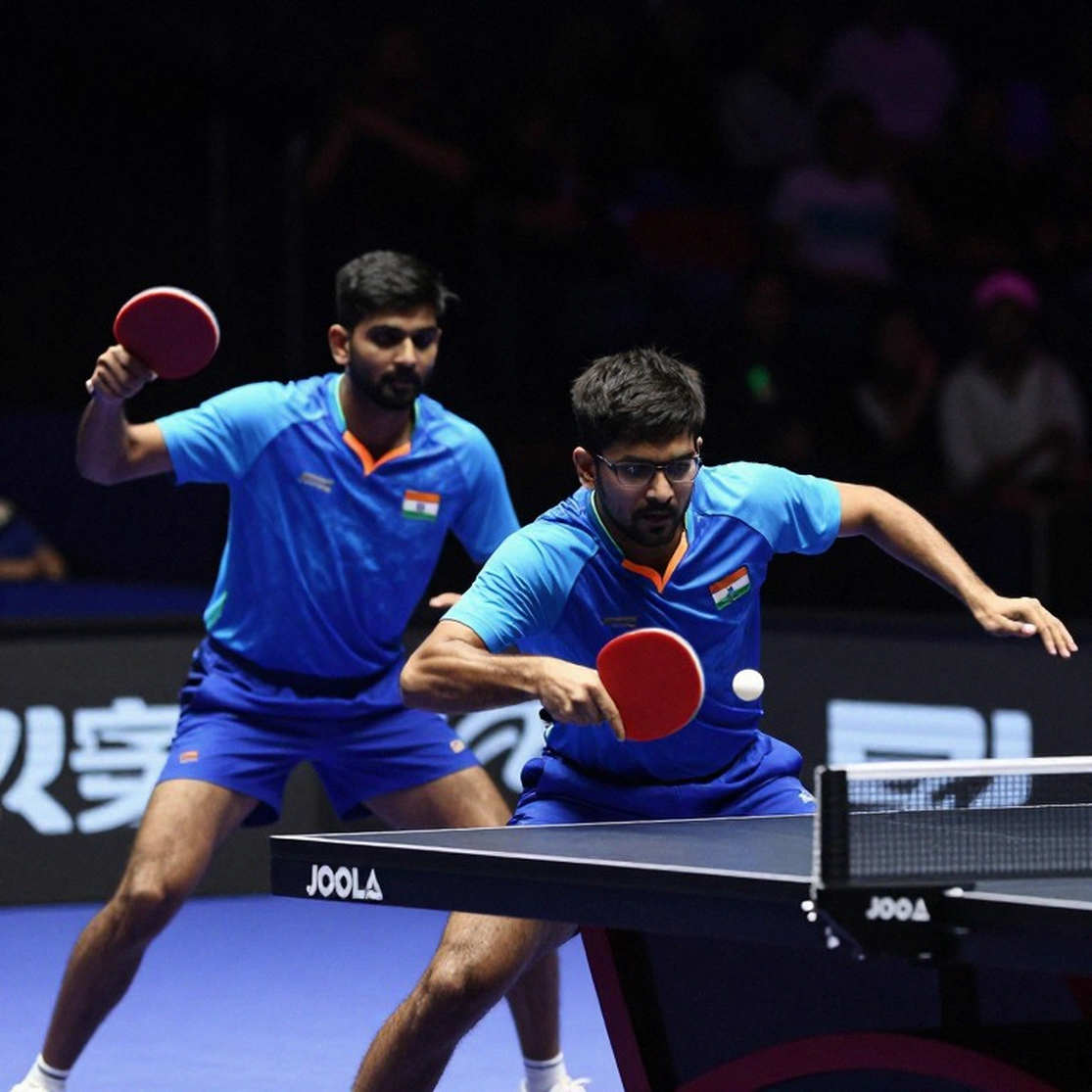
Twenty-seven years in this job have taught me that a story with no names in it usually says more than a story full of names. It says something about the person who spoke. Here, it shows that somebody chose to tell the story of a program instead of the story of a twelve-year-old.
That choice is sound communications practice. It also makes the analytical work much harder.
Where this event sits in the pyramid
ITTF Americas is the continental arm of the International Table Tennis Federation, covering the entire Americas region from Canada down to Argentina, plus the Caribbean. The U11 and U13 Championships is one of its products, sitting at the lowest tier of the official competitive system. Above it sit U15, then U19, then the WTT Feeder and Contender tiers, and only then the senior national-team circuit.
The age categories should be named precisely. U13 is commonly called Mini-Cadet. U11 falls under the Hopes program, the global grassroots development framework the ITTF runs for children roughly twelve and under. The fact that the organizers used both terms correctly suggests this was a template-driven event, not an improvised local tournament.
At this tier, no senior ranking points are awarded. There is no prize money. There is no Olympic or senior world championship quota attached. Its value lies elsewhere: it is a measurement point for the development pipeline. It tells you how many children a country currently has at exactly that age, how well they are coached, and how early they are pushed into international competition.
That is a narrow definition, and I want to keep it narrow. Most misreadings of youth events come from widening the definition too fast, turning a development result into a claim about strength.
Katy, Texas is a suburban city west of Houston. This is the single most important geographic detail in the whole report, and also the one readers skip past fastest. A continental championship staged on American soil, with a large, well-prepared host delegation competing in a hall a short drive from home.
The arithmetic of 56 medals
The most interesting part of this report is not the number 43. It is the structure behind it, and that structure can be tested with simple arithmetic.
Assume the tournament had fourteen events: seven U13 and seven U11. Each event awards one gold and one silver. If doubles and team events award two bronzes to the losing semifinalists, meaning there is no bronze-medal match, each event yields four medals. Fourteen times four equals fifty-six. The medal ceiling of the tournament matches the 56 figure exactly.
Now add it up: 14 gold plus 11 silver plus 18 bronze equals 43. The United States took 43 of 56, or 76.8 percent of all medals. And if the tournament's gold ceiling is fourteen, the host delegation took all fourteen. The gold conversion rate is 100 percent.
The arithmetic is internally consistent, which is why I read this structural interpretation with high confidence. When a set of scattered figures snaps into a closed shape on the first attempt, the probability that it is coincidence is far lower than the probability that it is an accurate description of reality.
What matters more is what comes next. Sweeping every gold at a continental championship does not prove that a country's youth table tennis is better than everyone else's. It proves something much narrower: at exactly U11 and U13, in exactly the Americas region, in exactly this year, no delegation was good enough to stop the hosts.
Those two statements differ in kind. The first is a judgment about quality. The second is a judgment about structure.
I once lived through a shock that taught me the difference. In 2026, I sat alone in a press room in Houston, rewatching all twenty-seven consecutive missed three-pointers by a team I believed was the best in the league. That team had the best model, the best data, and lost in Game Seven. I once believed in the model. The Rockets taught me that people break every model. Since then, every time I see a beautiful ratio, I ask one more question: what does this ratio measure, and on what sample.
Applied to Katy, the question becomes: what does a 100 percent gold rate measure? It measures the depth of a region, not the height of a table tennis nation.
The Americas is not Asia, and U13 is not U19
To see this clearly, place the result beside other regions at the same age group.
In Asia, U13 is a genuine battleground. Japan, China, South Korea, Chinese Taipei, Hong Kong and increasingly India all field youth squads very early. A delegation sweeping every U13 gold at continental level barely exists in recent history. Even when one nation is clearly superior, losing one or two events to an exceptional individual from another country is normal.
Europe looks similar. Germany, France, Romania, Poland, Sweden, Portugal and Czechia all run continuous youth development systems. U13 continental golds are typically split among four or five countries in a single edition.
The Americas is a different picture. Outside the United States, the region's more structured table tennis nations are Brazil, Canada, Puerto Rico, Argentina, Chile and Peru. Brazil is the region's senior powerhouse. Puerto Rico has a tradition of producing quality female players. Canada has relatively stable club infrastructure thanks to immigrant communities.
But at exactly U11 and U13, the depth of these nations is much thinner than at U19 or senior level. That is the crux. A country only needs a few dozen well-coached children at exactly that age to open a gap on the rest of the region, because the rest of the region has not yet assembled enough athletes at that age to compete.
In other words, the Katy result reflects a gap in infrastructure and selection scale at the lowest tier. It does not yet reflect a gap in coaching quality at the higher tiers.
Home advantage deserves a note here, because it is routinely underestimated at youth events. In table tennis, home advantage is not only the crowd. It is the familiar table, the familiar lighting, the distance from seat to court, sleeping at home, eating familiar food, and not flying twelve hours before a match that an eleven-year-old may remember for life. At this age, the technical gap between top players is small while the stability gap is large. Every non-technical variable gets multiplied.
But I have to be honest: home advantage can explain lifting a medal share from around sixty percent to around seventy-five percent. It cannot explain sweeping fourteen of fourteen golds. To sweep like that, the gap has to sit at the quality level, not only at the conditions level.
The coach's language, and what it does not say
The only person named in the entire report is Tim Wang, the U.S. national team coach. He is quoted on focus, on overcoming adversity, on fighting for every point.
That is psychological language. Not technical language.
What stands out is that in a report about a tournament the hosts won decisively, the spokesperson still chose to talk about adversity. Not about the training system. Not about technical structure. Not about the two-winged attacking template, the pivot, the construction of a rally. Only about fighting for every point.
At youth level, that phrasing has two readings. The first: the coach wants to teach his players that a clean sweep does not mean freedom from pressure, and that competitive character must be trained separately. The second: this is safe phrasing that avoids any technical claim in front of the media. From the available material, I cannot distinguish between them. I record both and choose neither.
What I can say with certainty is this: data speaks, but pain does not appear in the spreadsheet. A report made only of a medal table tells the reader nothing about the children who lost in the group stage, about the children who flew home empty-handed, about the matches where a ten-year-old cried in a stadium corridor. None of that makes the table.

One more point deserves clarity. The absence of any named athlete is almost certainly deliberate. For athletes under thirteen, limiting name exposure is sound media practice in many places. But that choice also shifts attention toward the program and away from the individual, which benefits the organization.
Analytically, the consequence is that we are locked at program level. No individual can be assessed. No playing style, no first-three-shot structure, no rally construction. Every technical inference must stop and declare its own limits.
The only inference I consider defensible, and I assign it low confidence, is at aggregate program level: a delegation sweeping continental gold suggests the overall technical base of that age cohort sat a full tier above the regional field. The dominant modern template among Western-trained juniors is a two-winged attacking game with the backhand as the primary weapon. But this is a result-level inference, not a technique-level one. I have no point-level data to support it.
The pipeline and the conversion trap
This is the most important part of the whole story, and the part nobody writes on results day.
The distance between a U13 gold medal and a senior national team spot is six to eight years. Anything can happen in that window. The conversion rate from outstanding junior to genuine senior is very low everywhere, including in the strongest development nations.
In the United States, three specific drags exist that other table tennis nations do not face, or face more mildly.
The first is school-sport competition. A twelve-year-old who is good at table tennis in America will be noticed by other sports. Basketball, football, baseball, swimming and track all have clear college scholarship pathways, media exposure and money. Table tennis has no equivalent university scholarship structure. That creates a pull away from the sport at exactly the age when long-term commitment is decided.
The second is cost. American table tennis training is mostly private-academy based. Coaching fees, individual lessons and out-of-state travel to tournaments add up. Families without means drop out before their child reaches U15.
The third is domestic tournament density. The absence of a dense national competitive circuit makes it hard for young athletes to accumulate enough high-quality matches during the critical window.
All three drags sit behind the Katy result. They do not diminish it, but they determine whether it becomes a long-term signal or just a good year.
Look at regional history and a pattern emerges. The Americas has produced genuinely world-class senior players. But they arrived through highly individualized paths, not through system depth. An exceptional athlete grows up with one coach, is supported by a committed family, and overcomes every obstacle on a personal route. That case proves the Americas can produce a top player. It does not prove the Americas can produce a top generation.
Katy is a signal about depth at the lowest tier. That is the most encouraging and simultaneously the most suspect kind of signal, because depth at U11 and U13 is the most volatile variable in any development system. It can be built quickly with a handful of good academies and a group of qualified immigrant coaches. It can also vanish quickly if those coaches move on or if one strong cohort graduates with no successor.
A counter-intuitive angle: what 76.8 percent actually measures
This is where I separate myself from the common reading.
When a report announces that one country won 76.8 percent of a tournament's medals, the natural reflex is to file that figure under "strength." But a percentage only means something when you know the denominator. What is the denominator here? All the medals at a continental championship, in the two youngest age groups, staged at home, with participation restricted to ITTF Americas member associations.
That is a small, narrow denominator inside a region whose competitive density at this age is far lower than elsewhere.
Change the denominator and everything changes. The same group of athletes, placed in an intercontinental U13 event featuring Asian and European delegations, would not produce the same ratio. That does not mean they are weak. It means we are measuring something with a ruler that only holds within a narrow range.
The biggest risk in this report is over-reading. A regional title at the youngest age groups is not a statement about global table tennis standing. It is an in-region development signal and should be read as one.
A second, lighter risk concerns data provenance. In the source material, no figure is tied to an independent source. The full medal table most likely originates from a federation-issued release. That does not make the figures wrong. It only means that before using them for any long-term conclusion, they should be checked against ITTF Americas' official records.
One further detail reads, for me, against the usual excitement. The absence of any named athlete reduces bubble risk. No "prodigy" is manufactured, no commercial pressure lands on a child. That is good for the child. It also reduces the report's analytical value to a minimum: no individual to track, no figures to compare, no match to dissect.
Underlining an old mistake
I keep one professional habit from my early years: whenever a result makes me want to draw a big conclusion, I force myself to write down a previous occasion when I was wrong in a similar direction.
In 2026, I concluded that a team's offensive model was good enough to win a title, based on a full season of data. That conclusion was wrong. Not because the data was wrong, but because I ignored a variable that does not appear in a spreadsheet: the human body in Game Seven of a series.
This time, the conclusion I want to draw is "American youth table tennis is rising in the Americas." I underline it and set it against my own test question: if this tournament were played ten times, in ten different venues, with ten different fields, how often would the same result appear?
I do not have an answer. And the absence of an answer is exactly why I keep every inference beyond the regional scope at low confidence.
What to track from here
Four signals are worth monitoring, in order of priority.
First, the conversion of this U13 cohort. Over the next one to three years, if these athletes appear at U15 and U19 continental events and keep contending at the top, the Katy result begins to carry long-term meaning. If they disappear from results sheets, what we saw was a moment.
Second, the strength of the rest of the region. If Brazil, Puerto Rico or Canada narrow the gold gap in future editions, the recent clean sweep said more about weak opposition than about a strong host. If the gap holds or widens, that is a real structural signal.
Third, hosting continuity. If ITTF Americas youth events keep landing on American soil, and new host cities appear, the real effect is not medals but the formation of a domestic youth circuit. That is the thing capable of changing the landscape over a decade.
Fourth, data verification. The medal totals should be checked against ITTF Americas' official records, including how bronzes are awarded in doubles and team events.
If this whole story had to be compressed into one line, I would write this. Every victory is a hypothesis that has not yet been falsified. The Katy victory is a clean hypothesis, neatly presented, with ratios that make people want to believe. It becomes fact only if it survives the next six to eight years: coaching changes, college admissions seasons, and children deciding to put down the paddle to chase a sport that offers a scholarship.
For now, the one thing I know for certain is this. In a suburban Houston arena, over one week, a group of children won nearly everything there was to win. And not one of them was named.
That is good news for them. And hard news for anyone who wants to know what actually happened on the table.