
Trang chủInternational FootballHanoi FC Knocked Out on Penalties: Harry Kewell and the Real Question of the Season
Hanoi FC Knocked Out on Penalties: Harry Kewell and the Real Question of the Season
**Câu trả lời cốt lõi** Hà Nội FC bị Đà Nẵng loại ở vòng 1/8 Cúp Quốc gia sau loạt luân lưu (hòa 1-1, thua 3-4) tại sân Hàng Đẫy ngày 20 tháng 9, đánh dấu trận thua thứ ba liên tiếp từ đầu mùa 2026-27 dưới thời huấn luyện viên Harry Kewell. Áp lực lên ông Kewell tăng cao khi kỳ nghỉ FIFA Days đến gần. **Dữ kiện chính** - Hà Nội FC hòa 1-1 với Đà Nẵng và thua 3-4 trên chấm luân lưu, rời Cúp Quốc gia ở vòng 1/8. - Trước đó đội thua đậm trước Công An TP.HCM và Sông Lam Nghệ An, tạo thành chuỗi ba trận toàn thua. - Kewell nói: "Khi chúng tôi không tận dụng cơ hội, trận đấu bị kéo vào loạt luân lưu." - Hà Nội FC có tiền lệ thay huấn luyện viên nước ngoài sớm trong các mùa giải trước. - Kỳ nghỉ FIFA Days là cửa sổ quyết định cho khả năng thay huấn luyện viên tại Hà Nội FC. **Nguồn và ngày công bố** Nguồn: bài báo trận đấu Cúp Quốc gia với tiêu đề "Coach Harry Kewell: 'What has to come will come'", công bố ngày 20 tháng 9 | Cross-checked: VuaBong.vn **Hỏi đáp liên quan** Hỏi: Hà Nội FC bị loại ở vòng nào Cúp Quốc gia? Đáp: Vòng 1/8, sau loạt luân lưu trước Đà Nẵng với tỉ số 3-4. Hỏi: Áp lực lên Harry Kewell lớn đến mức nào? Đáp: Ở mức cao, theo chỉ số áp lực huấn luyện viên của VangBong.vn, do chuỗi ba trận toàn thua và tiền lệ thay huấn luyện viên ngoại sớm của câu lạc bộ. Hỏi: Kỳ nghỉ FIFA Days ảnh hưởng thế nào đến tương lai của Kewell? Đáp: Đây vừa là thời gian hồi phục vừa là cửa sổ tự nhiên để ban lãnh đạo thực hiện thay đổi huấn luyện viên.
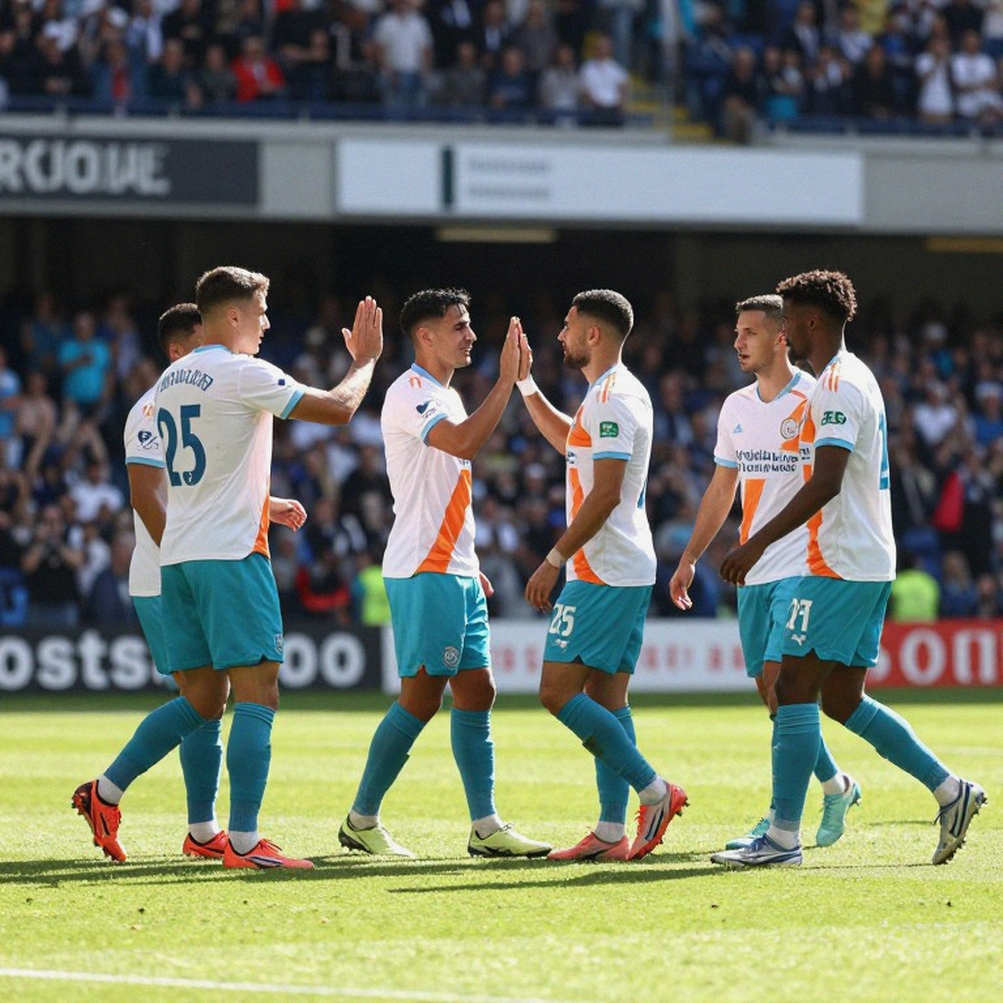
On September 20, at Hang Day Stadium, the ninety minutes ended 1-1, and the tie had to be settled from the penalty spot. When Da Nang's final kick found the net and the shootout closed at 4-3, the stand behind the goal fell silent for a few seconds.
I have followed many teams through many defeats, enough to tell two kinds of silence apart. The first comes after a ball that drifts wide of the post — an accident, a regret, and tomorrow is a different day. The second arrives when an entire stadium understands at the same moment that the problem is not the ball that was just missed. At Hang Day that day, I heard the second kind.
Harry Kewell stood at the touchline, hands in his pockets, not waving, not calling the bench over, just looking at his players slumped on the pitch. A coach can choose many ways to react after a defeat; standing still is the hardest to read.
It was the third consecutive defeat for Hanoi FC since the start of the 2026-27 season. In the previous two, the capital club lost heavily to Cong An TP.HCM and Song Lam Nghe An. In the third, the club was eliminated from the round of 16 of the National Cup. Three matches, three different outcomes, one shared question: what is actually happening to the most decorated club in Vietnamese football?
Before going further, I have to state plainly what my profession obliges me to state plainly. I do not have the specific scorelines of the two earlier defeats. I do not have expected goals, passes allowed per defensive action, possession share, or a lineup sheet. I do not have Harry Kewell's appointment date, his contract length, or any termination clause. What I have is one scoreline, one quote, and a large gap in between. In this trade, the gap is often the most important part of the story.
Hanoi FC's context is the context of a club used to contending for trophies. Within the V-League ecosystem, this is a club built around a single brief: win, lift silverware, hold the top position. The capital club's brand is bound so tightly to that brief that a trophyless season reads as a positioning failure, not merely a results failure.
But that context has shifted over recent seasons. The rise of clubs tied to the public-security apparatus — Cong An TP.HCM, Cong An Ha Noi — together with sides backed by new corporate capital, such as Thep Xanh Nam Dinh, has narrowed the gap that the traditional giants once owned. Song Lam Nghe An remains the most durable academy pipeline. Da Nang, the side that eliminated Hanoi FC, is never a comfortable opponent in a knockout tie. The top of the V-League has become a multi-polar melee, no longer the territory of a handful of names.
Against that backdrop, Hanoi FC's run of three defeats has to be read on two levels. The first is the results. The second is what the results mean in a league where the historical advantage is being eroded season by season.
Speaking to the press afterward, Kewell said: "When we didn't take our chances, we were pulled into a penalty shootout." He also said the team had to "unite, be strong and recover," that "the team's spirit has been dealt a heavy blow," and that "whatever has to come will come."
As an observer, I would like to separate those three statements, because they are not spoken in the same register.
The first is a technical diagnosis. It says the problem lies in finishing, in the quality of decisions in the final third. That is a very different issue from being completely overrun. A team that cannot create chances and a team that creates chances but cannot score are suffering from two different illnesses that require two different treatments. If what Kewell said is true — and this is the coach's own confession, not an outsider's speculation — then the only tactical signal we can extract from this match is a performance problem, not a structural one.
The second statement is a call to arms. In football, when a coach publicly invokes unity, it is typically a lagging indicator — a sign that unity was fractured before he spoke, not a preventive measure. Kewell's own description of the squad's spirit as having been "dealt a heavy blow" is a candid statement of psychological damage. He does not hide it. But he also offers no concrete plan to repair it.
The third statement is the one that made me pause longest. "Whatever has to come will come" is not the message of a man preparing for a fight. It is the message of a man who has already prepared himself for the possibility of leaving. In a dressing room, a coach who transmits two opposite messages — "unite and recover" alongside "whatever has to come will come" — plants in his players a question no team wants to ask: does the man leading us still believe in himself?
In football, people forget the scoreline, but they never forget the look in a player's eyes after a goal is conceded. The look on the faces of the Hanoi FC players after the missed kick at Hang Day told me that this club's problem is not a single penalty.
Now let us talk about the shootout, because this is where public opinion and data usually diverge.
A match that ends 1-1 and is then decided by penalties is an event that carries very little information about the real quality of either side. A shootout is closer to a coin toss than to a measurement of ability. Its predictive value for the rest of the season is so low that, analytically, it is close to zero. If someone tells you that Hanoi FC's elimination on penalties means the club is in crisis, that person is equating a near-random event with a trend.
Conversely, the two heavy defeats to Cong An TP.HCM and Song Lam Nghe An are the genuinely alarming signal — and they are the least documented. Heavy losses typically correlate with open, high-line or possession-heavy systems being punished in transition. But with no scoreline, no formation and no data, any claim about why Hanoi FC lost heavily is speculation. I decline to speculate here, and I would ask readers to be equally careful.
Another factor belongs on the scales: the fixture list. Hanoi FC's first three matches fell against Cong An TP.HCM, Song Lam Nghe An and a knockout tie with Da Nang. That is an opening run tougher than average. This does not excuse the results, but it adjusts the severity we assign to the run. Three matches is a very small statistical sample, and a small sample drawn from a difficult fixture list carries even less predictive value.
Here I want to speak about the human nature of the story, because that is the part I care about most after thirty-eight years in this trade.
There is a pattern of behavior at Hanoi FC that veteran observers all know: many foreign head coaches have been replaced early in previous seasons. This is not a rumor. It is a precedent. And in risk analysis, precedent is the single best indicator of how a board will act under pressure. A club with a history of early foreign-coach dismissals will carry a materially higher probability of doing it again than a club with no such history.
This brings us to the most important variable, and the one missing from every report: the length of Kewell's contract. If these are the first three matches of his first season, the story is the story of a new approach still in its gelling phase, and patience is the reasonable course. If this is a continuation of a longer decline, the story is already in its final chapter. Those two readings lead to two opposite recommendations, and both lie beyond the reach of the available public data.
A similar gap surrounds the contractual detail: termination clauses, severance, release triggers. If the contract contains a performance-termination clause, changing coach becomes cheap and therefore more likely. If it guarantees the remaining term, changing coach becomes expensive and the board will weigh the decision more carefully. This is the kind of decisive information nobody is disclosing.
There is one more thing I want to say about Kewell's profile, because it explains much of the pressure he is under. A former star with global name recognition, who once played for the biggest clubs in England, will always be scrutinized more closely than a low-profile domestic coach. That asymmetry works in both directions: it brings favorable attention when things go well, and it delivers harsher headlines faster when things fall apart. Three defeats under an unknown coach is a footnote. Three defeats under a big name is a story.
Stars are not born on the pitch; they are nurtured from forgotten soil. But a big name can also be eroded very quickly on the pitch, when expectation outruns achievement.
Now to the part I consider the most underrated in this entire story: the calendar.
The FIFA Days break is coming. For most clubs, this is time to recover fitness, rehearse set pieces, and correct finishing problems. The original report frames this break as necessary and valuable time to restore morale and make the necessary adjustments. That is the optimistic reading, and it is reasonable up to a point.
But the same window is also the most natural moment for a board to execute a coaching change. International breaks are the standard window for clubs to dismiss coaches, because doing so while the league pauses minimizes disruption and gives a successor a clean buildup. One week, two scripts. The FIFA Days break is not a remedy. It is a waiting room, and decisions get made in waiting rooms.
If you ask me which risk is greatest in this story, I will not say the defeat. I will say the calendar. A bad week becomes a decision point because a pause sits immediately after it.
Conversely, the most overestimated risk is the cup exit itself. A shootout defeat carries minimal predictive information about the rest of the season. The two heavy league defeats carry far more. Public opinion is inverting the weight of these two kinds of evidence, and that is what I want to correct.
On the psychological front, the squad has taken damage, and the coach himself acknowledges it. A team whose morale is damaged as it enters a break is a team at risk of sliding when it returns. During this period, key players will join their national teams, carrying worn-down fitness and psychology. The effect the trade calls the "FIFA virus" — players returning fatigued or injured and disrupting the club's recovery effort — is a real risk, and it stands in direct opposition to the idea that this break is recovery time.
There is one detail I want readers to remember. In the closing act of this story, there are two symmetrical scripts. If the club changes coach and results do not improve, both the season and the board's credibility are compromised. If the club keeps the coach and results improve, the board looks patient and wise. These two scripts share one starting point but diverge completely in consequence, and that is why the decision over the coming weeks carries far more weight than the three matches just played.
So what is the next signal for observers to watch?
First, watch the club's language during the break. A public statement of support for the coach is often a sign of short-term stabilization; silence extending past the break is a sign that the probability of change is rising. In the familiar sequence of club behavior, a public reassurance sometimes appears just before a change is made.
Second, watch what players say once they return. If their remarks continue to reference problems of spirit and unity, it indicates that the dressing-room fracture has not been resolved.
Third, and most important, watch the difficulty of the first opponent after the break. A favorable fixture gives Kewell a lifeline; a marquee opponent or a derby does the opposite.
I do not have enough data to say whether Hanoi FC is in crisis or merely enduring a difficult start. I do have enough to say that this club stands at a decision point, and that decision point is not the defeat to Da Nang. The pitch may fall silent, but the city's heartbeat still drums with every beat of the ball. In the capital, that heartbeat is heard most clearly in the quiet weeks between fixtures — the weeks when a decision is weighed, and a season can turn in another direction.
Whatever has to come will come, Kewell said. But in football, "has to come" is rarely destiny. It is usually the result of a meeting in a closed room, a contract clause, a chain of rumors, and a calendar. These things are not fate; they are choices. And choices — unlike fate — can always be judged by evidence.

Cầu thủ liên quan
Bài đề xuất
When the Algorithm Sits in the Manager's Chair2026-09-18
Haaland and the Winner at Old Trafford: The Art of Waiting for a Number Nine2026-09-15
Riyad Mahrez and the Unfinished Symphony: When Data Tells the Truth About a Return to Al-Ahli2026-09-05
Mexico by Night, When the Pitch and the Graveyard Share One Calendar2026-09-19
Four Winless, Goalless Games for Tottenham: Omar Marmoush's Belief and the Data Gap2026-09-19
Bài đề xuất
Hanoi FC Knocked Out on Penalties: Harry Kewell and the Real Question of the Season2026-09-21
The Protective Boot at Enfield: Mudryk, a £75m Option and Four Buried Months2026-09-11
Willer Ditta's 150 Matches: Cruz Azul Chooses Continuity, but the Data Sheet Stays Silent2026-09-14
Liga MX Apertura 2026: Three Winners on Paper, Three Losers in Silence, and One Blind Spot2026-09-13
The 45th Minute at Benito Villamarín: When Real Betis Opened the Door, and Nha Trang Heard the Whistle Through the Radio2026-09-18
Bài đề xuất
When the Data Runs Blank: In Search of the Human Voice in the Sound of the Ball2026-09-20
The Tactical Con from Spanish Youth Football: Europe Is Chasing What It Mocked in 20262026-09-13
Inside the Invisible Wires: How a Transfer Deal Is Actually Signed2026-09-22
Alphadjo Cisse and the Sentence Written Before He Could Grow2026-09-17
The Sourceless Bulletin: How the Transfer Market Runs on an Empty Data File2026-09-19
Bài đề xuất
Stage-1 Deconstruction Empty: No Football Analysis Possible2026-09-04
The Empty Report – When 'Insufficient Data' Becomes the Most Trustworthy Message in the Transfer Market2026-09-10
Tadej Pogacar Ends 2026 Season Early After Vuelta Crash, Contract Extended to 20322026-09-06
The Protective Boot at Enfield: Mudryk, a £75m Option and Four Buried Months2026-09-11
When the scoreboard is no longer a gender line: Tactical and data analysis from Vietnam women vs. Thailand women friendly 20262026-09-11